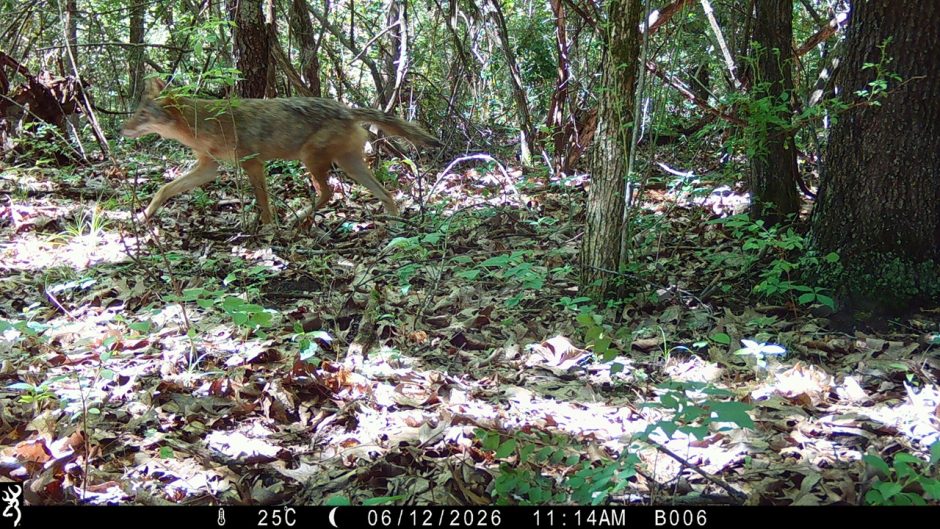
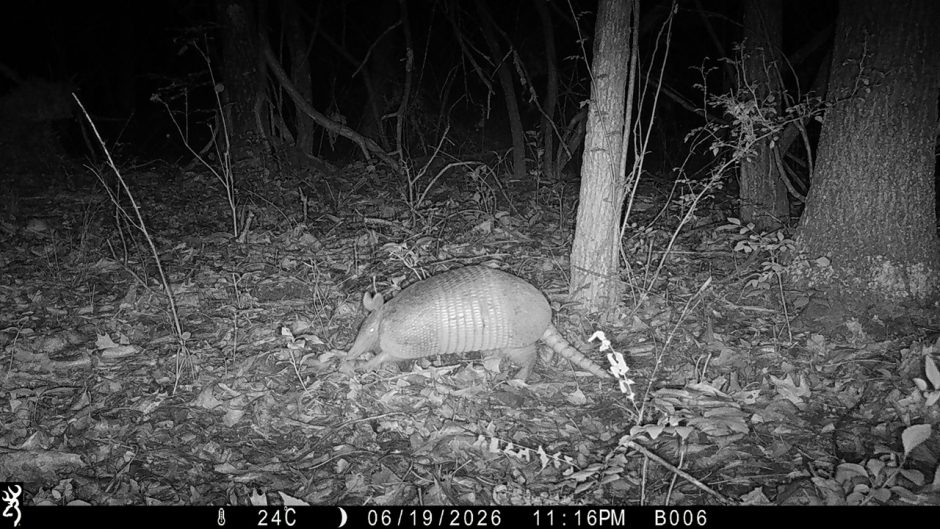
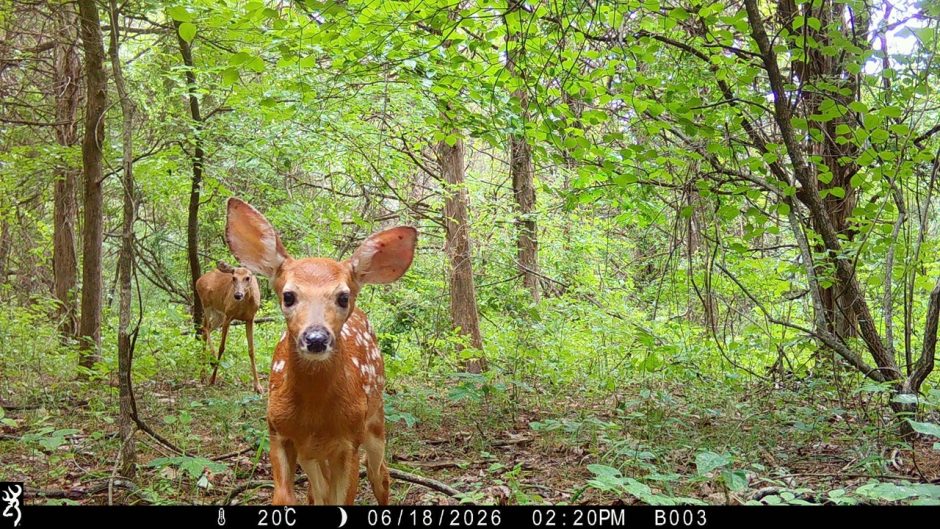
A coyote slips through the woods at dawn. An armadillo wanders past a camera at night. A doe and fawn pause together along a forest trail. These are just a few of the moments captured among roughly 12,000 wildlife photos collected this summer by University of Missouri researchers and students in Baskett Forest.
Mizzou’s observations are contributing to the Smithsonian’s Lewis and Clark Resurvey, one of the largest wildlife studies ever conducted in the United States. Led by ecologists at the Smithsonian’s National Zoo and Conservation Biology Institute, the national project is retracing the original route of the Lewis and Clark Expedition to see how wildlife has changed over the past 200 years.
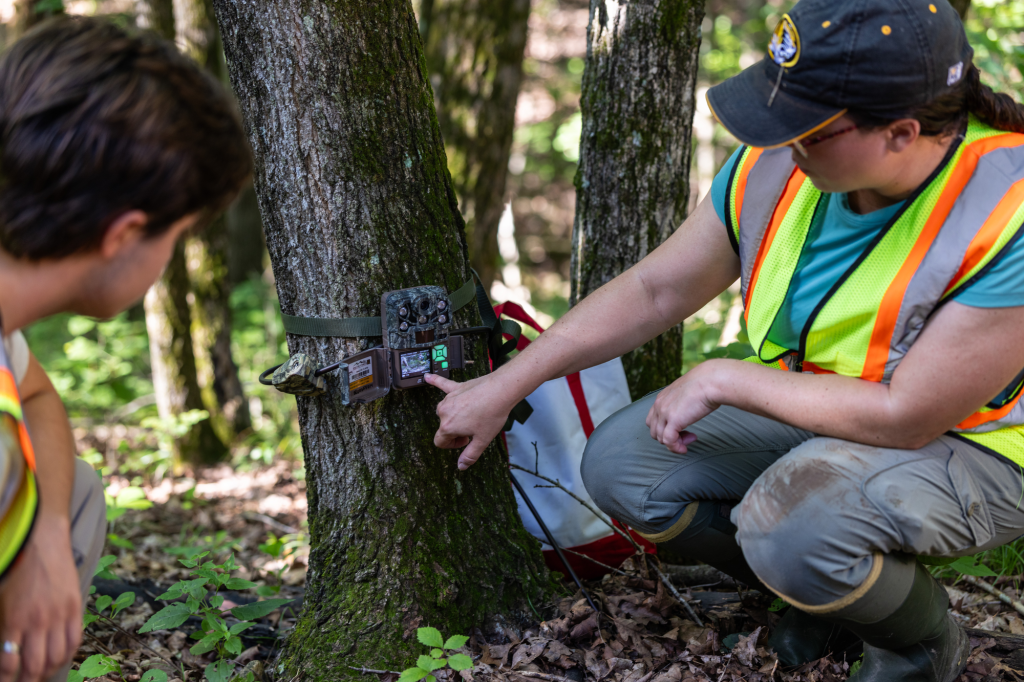
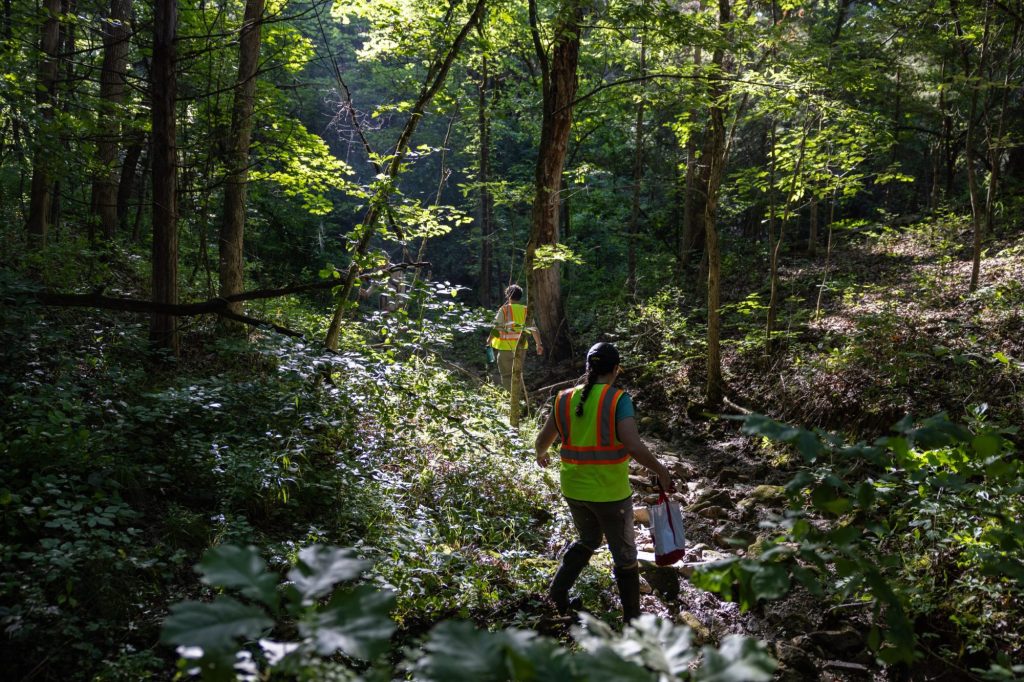
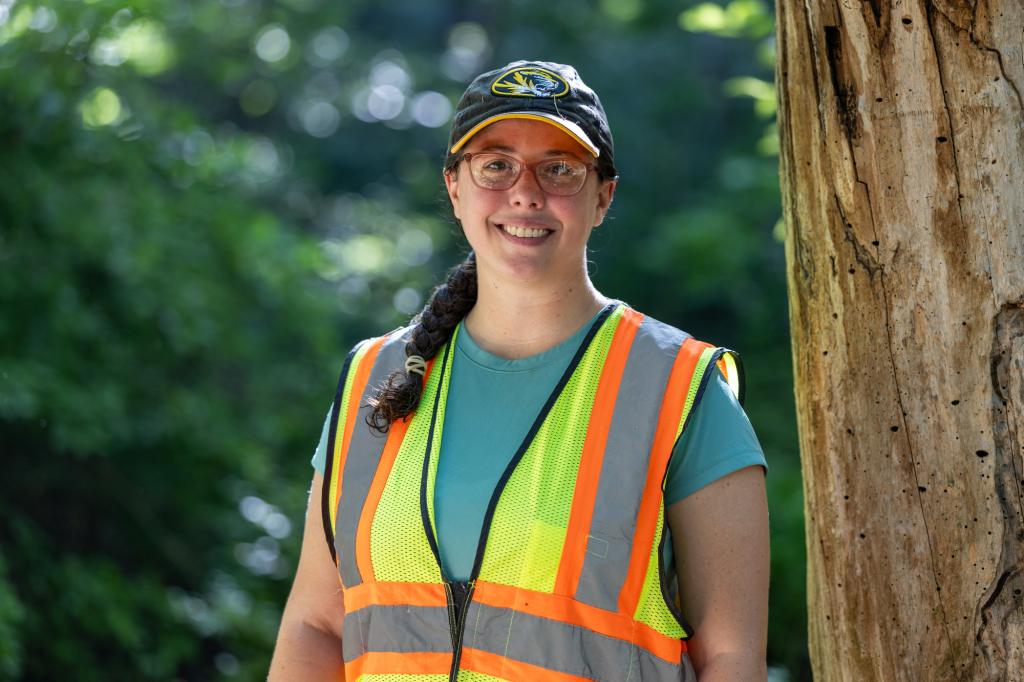
For the project, Christine Brodsky, an assistant professor of urban ecology in Mizzou’s College of Agriculture, Food and Natural Resources, worked with students to deploy 15 motion-activated trail cameras throughout Baskett Forest, a 2,000-acre research property in Boone County.
As part of the Central Missouri Research, Extension and Education Center (CM-REEC), Baskett serves as an outdoor classroom and living laboratory for students, faculty and staff. CM-REEC is one of four centers that make up the Missouri Agricultural Experiment Station, supporting research and experiential learning that helps address real-world challenges across Missouri and beyond.
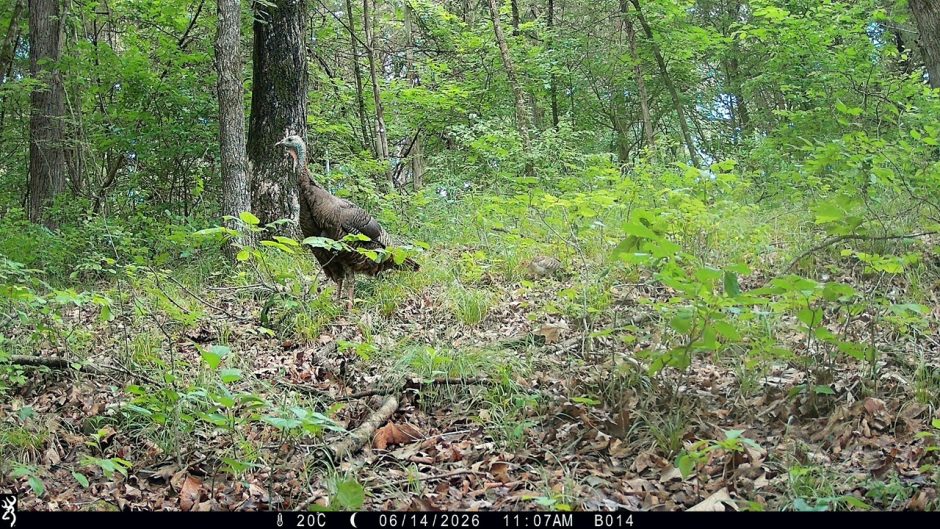
Because of its proximity to the Missouri River and the historic expedition route, Baskett was selected as one of the national study sites. The images reveal a diverse wildlife community in mid-Missouri, from wild turkeys and raccoons to Virginia opossums, eastern gray squirrels and armadillos.
“When people see a deer, coyote or wild turkey moving through the landscape, it creates an immediate connection,” Brodsky said. “These are animals many people recognize from their own neighborhoods, but they rarely have the opportunity to observe them in their natural habitats. Others, such as the armadillo, were once uncommon in Missouri and continue to appear farther north and in new habitats. These observations provide researchers with valuable clues about how animals respond to shifts in environmental conditions.”
Retracing history
To gather the necessary wildlife data for the project, the Smithsonian partnered with more than 100 organizations, including Mizzou, to place dozens of trail cameras along the approximately 5,000-mile Lewis and Clark Historic Trail.
The overall effort is expected to generate nearly 4 million images. Once all the photos are collected from across the country, scientists will compare today’s animals with the original wildlife observations recorded in Lewis and Clark’s expedition journals.
Scientists will use the data to examine how species distributions, habitats and biodiversity have changed across the United States over the past two centuries.
“The timing of this project with the 250th birthday of America allows us to honor the early scientific exploration tasked by President Thomas Jefferson to record the continent’s flora and fauna,” said Brigit Rooney, coordinator of the Smithsonian’s Lewis and Clark Resurvey. “By comparing modern wildlife observations to historical records, our resulting research efforts could help inform conservation strategies for decades to come.”
A living classroom
From the start of Mizzou’s part of the project, students took on a central role. They set up and maintained the trail cameras, reviewed thousands of photographs, identified species and helped organize the growing dataset. These tasks gave them valuable hands-on experience in wildlife identification, data management, field navigation and ecological analysis.
“Students aren’t just learning about wildlife research in a classroom,” Brodsky said. “They’re making meaningful contributions to science. Projects like this help them develop the skills and confidence to become the next generation of conservationists and wildlife ecologists.”
For Brodsky, the effort highlights what makes Mizzou uniquely qualified for this type of national project.
“We combine world-class research, outstanding natural resources and hands-on student learning opportunities,” Brodsky said. “Our students are helping answer important questions about America’s wildlife while gaining valuable experience outside the classroom.”
This story originally appeared on Show Me Mizzou. Want more stories like this? Subscribe to the Show Me Mizzou newsletter.