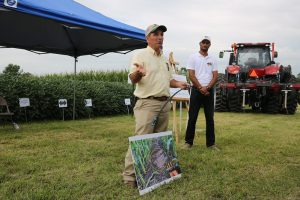
As MU State Extension Specialist in agronomy Kelly Nelson says, Missouri is “one day away from a flood, and 10 days away from a drought.” It is a reality farmers face each growing season. Too much water can cost bushels and delay planting. Too little can stress crops during critical growth stages.
“Water is the soul of everything,” Nelson said. “You can survive days without food, but it’s the water you need.”
At MU’s Drainage and Sub-Irrigation Research Facility (MUDS), researchers are studying how water moves both below the soil surface and across Missouri’s rolling landscapes to help farmers protect yields, nutrients and long-term soil health.
Nelson has been part of MUDS since it began, arriving at Mizzou in 2000. He then established the long-term research site at the Northern Missouri Research, Extension and Education Center’s Lee Greenley Jr. Memorial Research Farm near Novelty.
“It was critical to establish a site to look at the long-term effects of these systems,” Nelson said. “We see changes in hybrids, crop varieties and technology over time. We have to understand how these systems work in the extremes.”
Northern Missouri’s claypan soil consists of a silt loam layer over a dense clay layer that holds water near the surface, making the region well-suited for such research. Nelson’s team evaluates subsurface tile drainage systems — perforated pipes buried below the soil that lower the water table and help excess water leave the field more efficiently. Researchers then compare those results with non-drained controls to quantify what farmers gain by investing in drainage.
By 2017, Nelson and his team had expanded their work into drainage-water recycling, launching one of the Midwest’s largest replicated recycling research sites. In 2019, they added an on-farm reservoir that stores drainage water for reuse.
Those shifts began reflecting a broader goal for MUDS: treating water as a resource to be managed, not just a problem to be drained away. By routing the drainage and surface water runoff through on-farm reservoirs, the team can capture not only sub-surface water but also dissolved nitrate and phosphorus that would otherwise leave the field. Nelsn’s research has shown that controlled drainage and drainage-water recycling can reduce nutrient losses while maintaining or improving yields, turning a potential liability into an asset.
Man-Made Floods
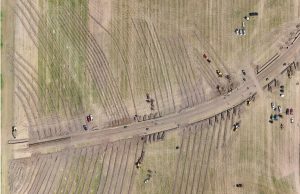
In a series of flooding studies, Nelson and fellow College of Agriculture, Food and Natural Resources researchers Gurbir Singh and Gurpreet Kaur, saturated corn at different growth stages and measured how quickly yields dropped under saturated soil conditions. Depending on the hybrid, its yield potential and the timing of the flooding, losses have ranged from five to 31 bushels per acre per day. Similar experiments in soybeans have shown up to two bushels per acre per day under saturation, adding up to roughly 14 bushels lost in a single week with a single flooding event.
Those numbers help provide farmers with concrete data to guide how, where and why to invest in drainage. After all, just one flood “can be detrimental” to growers, Nelson said.
From there, the team has gone on to evaluate soil health, enhanced-efficiency fertilizers, gas emissions and edge-of-field water quality. Their work involves innovative edge-of-field practices including saturated buffers and woodchip bioreactors. These systems function as on-farm water treatment facilities that use natural processes to convert nitrate in drainage water to nitrogen gas before it reaches downstream lakes and rivers.
Stewards of the Land
Working closely with farmers, Nelson said many already understand the long-term value of drainage and water management, but implementing those systems often means balancing conservation goals against tight margins and significant up-front infrastructure costs.
“Farmers are stewards of the land,” he said. “To leave a legacy for the next generation, having highly productive soil and water management is a key component of our research efforts.”
Well-designed drainage and water recycling systems can help reduce nutrient losses, protect drinking-water reservoirs from sediment and algae problems and could even soften the peaks of downstream flooding by spreading storage across many smaller on-farm structures.
CAFNR Collaboration
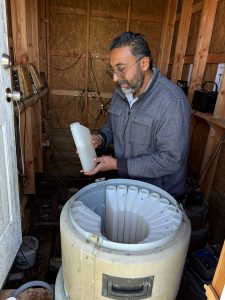
Nelson is quick to point out that none of this work happens alone. He credits advisory board members, contractors, students and collaborators such as Singh and Kaur with shaping the next set of research questions and expanding landscape and drainage water management research in new directions.
Singh, the state extension specialist in soil science, agroecology and landscape management, focuses his research on how water moves across hillslopes and terraced fields, pools in low areas and shapes crop performance, as well as nutrient movement and fertilizer needs.
“My work is putting recommendations in a package for the crop land, which is variable in productivity,” said Singh.
Singh uses high-resolution elevation data and topographic position modeling to classify sections of fields as summits, shoulders, backslopes, footslopes or channels. Those classifications help researchers identify where water tends to collect and where crops tend to struggle or thrive, meaning a one-size-fits-all fertilizer strategy leaves money on the table.
“If I just treat my field as a blanket application of nutrients, I will never be profitable,” Singh said. “I need recommendations based on the productivity of the soil, and the productivity of the soil is dictated by the landscape positions.”
Soil Health
Between 2019 and 2022, Singh and fellow researchers found that when they added a nitrification inhibitor to nitrogen applications in chronically wet, low-lying areas, corn yields increased by 20 to 30 bushels per acre in those positions — proving they could turn a problem spot into a profitable one, without needing a blanket application across the whole field.
“The first step is to improve drainage,” Singh said. “Once the drainage is improved, now I can start looking at fertility management.”
Taking it a step further, Singh established a water-quality lab at Greenley in 2022 to measure nutrients, especially nitrogen, that leach through the soil profile or leave the field through surface water runoff. There, his team can process samples on site while training students to run advanced analyses themselves. The lab, eh said, gives them a way to tackle “questions that traditional agronomy cannot answer” without leaving Novelty.
Looking ahead, Nelson and Singh say they have more to uncover for Missouri farmers. The landscape position trials might be in their fourth year of existence, but Singh said researchers are continuing to build on those findings.
“We’ve only just scratched the surface,” Singh said. “My predecessors showed us the variability. Now our job is to turn that into practical recommendations farmers can use.”
Impact in Action: Extending the Reach of MUDS
For northeast Missouri contractor Chris Beach, early experiences with Nelson’s drainage research shaped a career in helping bring those practices to farmers’ fields across the region.
Beach first encountered Nelson’s research as a high school student through his FFA chapter, helping install one of the original pattern tile research systems at Greenley.
Years later, after college and time in a corporate job, Beach returned to agriculture. Around 2006, he started a drainage business with a partner, installing subsurface tile systems for farmers and landowners.
While he understood installation, Beach wanted to better understand how systems should be designed for different soils and landscapes. That’s when he reconnected with Nelson.
“I went back to Kelly to learn a little bit more than just being the guy down in the hole cutting the pipe and attaching the pipe,” he said. “I wanted to learn what he had accomplished through his study.”
Nelson helped Beach expand his knowledge of everything from sizing mains and spacing laterals to evaluating how soil types influence drainage performance. Even today, he still looks to the MUDS team when questions arise on challenging projects.
One project on his family’s operation stands out. After installing a full pattern tile system, his brother harvested his first full stand on a 20-acre field without replanting in 2013 — the first time since purchasing the farm in 2005.
Nearly 13 years later, Beach still sees the impact drainage can have on challenging acres.
“The benefits are helping a farmer grow a better crop in an area where they were not having a good ROI,” Beach said. “Being able to get them more bushels per acre off the same ground that they were already putting the same amount of inputs into.”