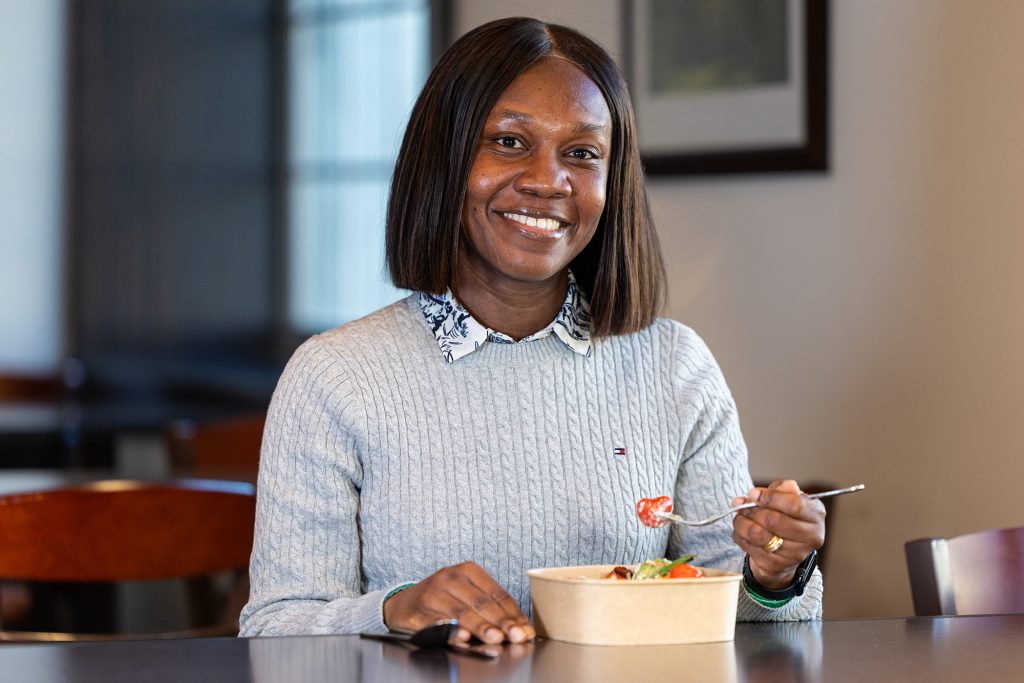
University of Missouri researchers are revealing the powerful role of nutrition in rebuilding gut health by uncovering how the intestinal microbiome repopulates after a colonoscopy.
The gut microbiome is the ecosystem of microscopic organisms living inside the intestines. It’s vital to human health, as differences in its function and composition have been linked to the risk of development of chronic conditions such as obesity, type 2 diabetes, inflammatory bowel disease and cardiovascular disease.
Katherene Osei-Boadi Anguah, an assistant professor of nutrition and exercise physiology, recognized the benefit of screening colonoscopies for the study: Preparing for the procedure substantially wipes out the microscopic organisms and presents a clean slate for tracking how the gut microbiome repopulates and how nutritional components, such as dietary fiber, might affect it.
Anguah, a faculty member in the College of Agriculture, Food and Natural Resources, leveraged Mizzou’s collaborative research community by partnering with researchers in the School of Medicine, College of Veterinary Medicine and MU Health Care.
Patients who were already scheduled for a routine colonoscopy were recruited to the study and screened for age and a lack of gastrointestinal health issues. The gut microbiome was tracked prior to and two weeks following the procedure. The participants were taught how to keep detailed food-intake logs, which were collected before the procedure and for two weeks after to monitor their unrestricted diets.
Researchers found that about 70% of key beneficial microscopic organisms included in the analysis were depleted three days after the colonoscopy, with the gut beginning to rebound around day five.
The study also revealed a sharp drop in patients’ energy on the day before the procedure due to the all-liquid diet, followed by a “catch-up” effect as participants increased their food consumption in the days immediately afterward to compensate for the caloric deficit.
After the procedure, the quantity, timing and nutritional makeup of food intake — specifically the amount of fiber — played a role in how quickly the microbiome repopulated.
Before the colonoscopy, participants’ fiber intake was higher than typically consumed by most Americans, though below the recommended daily levels. On the day of colonoscopy, their fiber consumption dropped but returned to their baseline intake by the second day. The findings suggest at least two days of food intake are needed to repopulate the gut microbiome after the substantial disruption caused by the colonoscopy preparation.
“We believe the diversity of the microbiome for the individual subjects could be explained by this fiber intake,” Anguah said. “Recovery of the microbiome coincided with when the subjects’ fiber intake came back to the pre-procedure levels.”
While the researchers expected the colonoscopy preparation to kill off most of the gut microbiome, they were surprised to discover that some pathogenic bacteria actually increased. This suggests that disrupting the gut ecosystem could result in increased risk of harmful bacteria growth and infection.
These results pave the way for future research that will inform how dieticians and gastroenterologists provide dietary counseling to patients.
“Future studies would seek to explore how fiber intervention would aid in the repopulation of the gut microbiome and whether fiber intervention might ameliorate the effect of those pathogenic bacteria that we observed in our study,” Anguah said.
The study “Repopulation of the gut microbiota after a screening colonoscopy” was published in PLOS One.
Co-authors are Aaron Ericsson from Mizzou’s College of Veterinary Medicine; Jennifer Anderson and Jessica George from Mizzou’s College of Agriculture, Food and Natural Resources; Elizabeth Parks from Mizzou’s School of Medicine; and Yezaz Ghouri from SSM Health Medical Group.
This story originally appeared on Show Me Mizzou. Want more stories like this? Subscribe to the Show Me Mizzou newsletter.