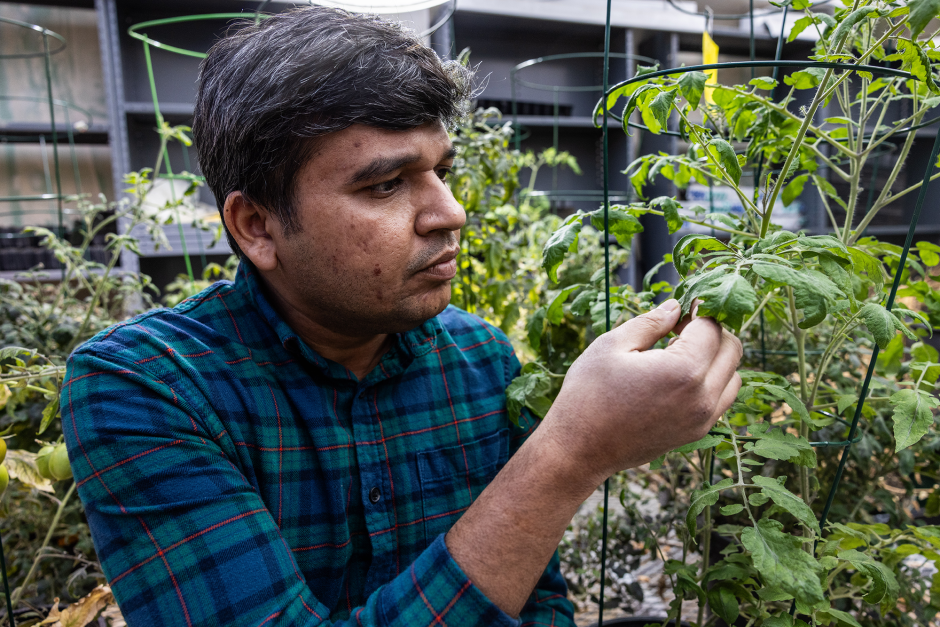
Prashant Sonawane, assistant professor of biochemistry, says plants are “magicians.” If so, that must make Sonawane and his lab magician’s assistants.
Sonawane’s research identifies and synthesizes natural products from plants that have applications in human health – in his lab, that includes cancer and Alzheimer’s.
A new grant from the National Institutes of Health will accelerate these discoveries, he said. And that’s exactly the purpose behind the type of grant Sonawane received – Maximizing Investigators’ Research Awards (MIRA) provide investigators with “greater stability and flexibility,” enhancing scientific productivity and the chances for important breakthroughs, according to the NIH website. The grant will provide $2.2 million total to Sonawane’s lab over the next five years.
“The sky is the limit for us now,” he said. “It’s unusual for plant scientists to receive NIH grants. Our research project is very well aligned with NIH’s mission.”
Sonawane is one of just a few researchers who work on biosynthesis of plants’ natural products, or specialized (secondary) metabolites. His lab has already successfully engineered a natural plant molecule from black nightshade now FDA approved for treating liver cancer.
“No one knows how these molecules are made,” he said. “And the plant produces them in very small amounts, usually for their own defense against pests and pathogens. We’d like to scale that amount up to be useful for further applications.”
First, Sonawane’s team uses metabolomics coupled with transcriptomics to understand promising compounds produced by a certain plant – they are typically exploring 10-15 plant species at any given moment. They use that foundational knowledge to then synthesize, or engineer, the compounds. Biosynthesis can take anywhere from five to 20 steps – sometimes even more than that.
“Everything is new to us. Each molecule is different – each is produced differently,” he said.
New to their research process? Sonawane’s lab can then test the synthesized molecules for effectiveness thanks to a partnership with the Paul De Figueiredo lab in Bond Life Sciences Center.
“Mizzou had everything that I wanted, including facilities and colleagues,” Sonawane said of his decision to join the university two years ago. “Mizzou Biochemistry hosts a lot of plant scientists. The Interdisciplinary Plant Group (IPG) has a very strong plant metabolism community; we do a lot of collaborative research now.”
In fact, Sonawane believes Mizzou is leading in this emerging field – IPG plans to host a plant metabolism symposium next year, for example. Sonawane sees a new generation of scientists benefiting from the unique work in his lab specifically and at Mizzou in plant sciences in general.
Sonawane didn’t set out to become a plant biologist, he said – he rather had a knack for mathematics, and didn’t necessarily enjoy his undergraduate biology courses. But during graduate school he had a professor who would list hundreds of plants and their important compounds during class.
“It was very fascinating for me,” he said. “How can plants have this capacity? Each one can produce different molecules that have different implications. Plants are not just for food, fiber, fuel, nutrition… there is so much importance for medicine, too.”
He imparts this fascination with and love for plants to his lab team – they also grow all of the plants used in their research.
“We are very passionate,” he said. “I always tell my students – I don’t need the people who know everything. I always look for motivation and compassion from students.”
This mindset is tied directly to the land-grant mission of Mizzou and CAFNR, which Sonawane describes as “making lives better through scientific outputs.”
Although the lab’s research looks to medicinal properties of plants, their findings also have potential applications in agriculture as these compounds can be used as natural plant protection agents.
“Currently, nearly 30% of FDA drugs have a plant origin,” Sonawane said. “That number will go much, much higher as we explore.
“Mizzou has a very strong plant community – and it’s only becoming stronger.”