Stories
Nov. 12, 2024
Celebrating our distinguished alumni: CAFNR Column Awards 2024
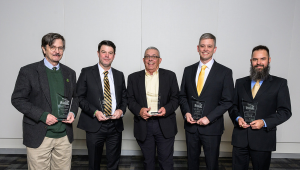
From left to right: David Larsen, Jonathan Dyer, Blake Hurst, Joel Spencer and Julian Lenis. Not pictured: Kendra Kattelmann. The College of Agriculture, Food and Natural Resources honored six recipients with the 2024 CAFNR Column Award for Distinguished Alumni. This is the only award specifically for alumni presented by the college – the highest honor bestowed by the College in celebration of outstanding alumni. The awardee class includes one graduate from each of CAFNR’s six divisions, reflecting the six historic columns at the University of Missouri. View the event photo album. School of Natural ResourcesDavid LarsenB.S. Forestry ’78, M.S.
Nov. 11, 2024
Q&A with first-generation student Laci Fuhlage
In honor of National First-Generation Student Week, Laci Fuhlage, junior agricultural education major from New Franklin, Missouri, discusses her experience as a first-generation college student.

Nov. 11, 2024
Q&A with first-generation student Cameron Lor
In honor of National First-Generation Student Week, Cameron Lor, senior natural resource science and management major from Lee's Summit, Missouri, discusses his experience as a first-generation college student.

Nov. 11, 2024
Q&A with first-generation student Branden Lor
In honor of National First-Generation Student Week, Branden Lor, senior natural resource science and management major from Lee's Summit, Missouri, discusses his experience as a first-generation college student.
Oct. 30, 2024
Animal Sciences Ph.D. student awarded travel grant for Plant and Animal Genomics Conference
Hunter McConnell, an Animal Sciences Ph.D. student, has been awarded the NRSP8 Travel Award to attend the 2025 Plant and Animal Genomics Conference (PAG32) in January.

Oct. 30, 2024
Uncovering roots of agricultural simplification: NSF grant fuels SNR professor’s mission to transform farming practices, revitalize rural communities
American farmers have cherished their symbiotic relationship with the land they farm for generations. They care for the land, and the land provides a bountiful harvest that feeds the nation in return. But, what if, somewhere along the way, in that effort to care for the land, we got “stuck” and found ourselves in systems that no longer served the land we tend and depend on so much?
Oct. 28, 2024
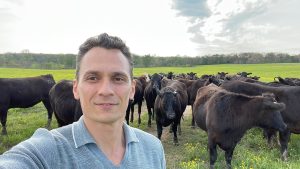
Q&A with Thiago Martins
Thiago Martins is an assistant professor in beef reproduction, extension and research.
Oct. 28, 2024
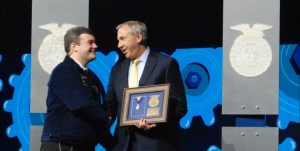
Dean Daubert Awarded Honorary American FFA Degree
Christopher Daubert, Vice Chancellor and Dean of the College of Agriculture, Food and Natural Resources, was selected to receive the Honorary American FFA Degree.
Oct. 28, 2024
Message from Harvey James
Welcome to the Fall 2024 edition of the Division of Applied Social Sciences (DASS) alumni newsletter! I am Harvey James, Director of the Division. I was formally appointed Director in March of this year. I was Interim Director for about 15 months prior to that. Some of you may know our previous Division Directors: Joe Parcell (2017-2022), Jill Findeis (2011-2017), and the late Mike Nolan (1995-2011). DASS is one of six Divisions within the College of Agriculture, Food and Natural Resources (CAFNR). Our focus is on the social sciences. The other five divisions (animal sciences; plant science and technology;…
Oct. 28, 2024
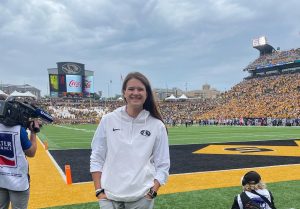
Parks, Recreation, Sport and Tourism alumni begin their careers through connections to Mizzou Athletics
Through the Parks, Recreation, Sport and Tourism degree program, CAFNR students can complete their senior capstone with Mizzou Athletics before potentially moving into a full-time staff role.