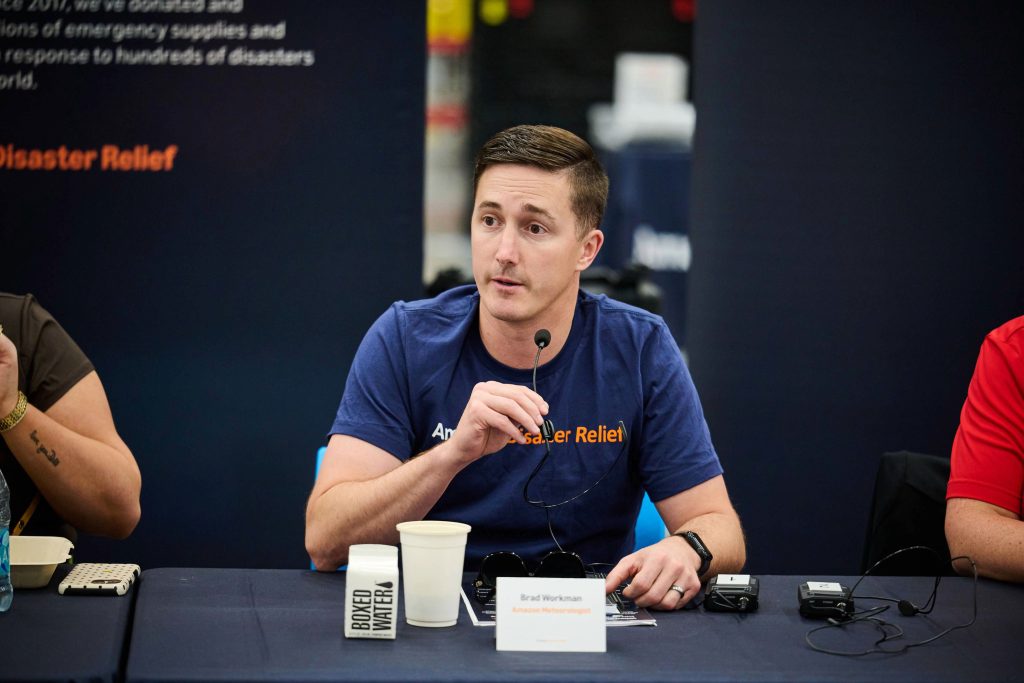
Working for one of the world’s largest companies, Brad Workman’s day-to-day role as Amazon’s chief meteorologist comes with big responsibility.
“My job is to best position Amazon to prepare, respond to and mitigate weather impacts,” he said. “Ensuring the safety of all of our associates and partners is my number one priority.”
Just like millions of people rely on Amazon to deliver crucial goods to them, the company’s delivery operations rely on Workman to make sure they can complete their work safely.
“My job is to give the signal about expected weather impacts across the country so that leadership can make informed decisions when actions need to be taken to ensure the safety of all of our associates and partners,” Workman said.
Beyond daily operations, Workman also serves as a subject matter expert who helps Amazon and its partners develop new tools to improve the way the company responds to weather. This includes Amazon’s Disaster Relief team, which donates and delivers relief items to communities impacted by severe weather around the world.
“Partnering with the Amazon Disaster Relief team has given me a firsthand look into how we are using our incredible scale, resources and expertise to help communities respond to natural disasters,” he said.
No straight line to success
Workman received his bachelor’s and master’s degrees in atmospheric sciences from the University of Missouri in 2011 and 2013. Before stepping into his current role in 2024, Workman’s career path hasn’t been a conventional one for most meteorologists.
“I tried the conventional route, but found blocks along the way,” he said. “I’ve learned that the most valuable skill in life is the ability to adapt and respond to changing situations. One door closing doesn’t mean the end – it just means a new door is ready to be walked through.”
Workman started his career at an engineering firm working on hydrometeorological projects and flash flood forecasting in Colorado. He then worked for a severe weather research institute for a few years before entering the finance sector.
“From 2020 to 2024, I worked for a financial services firm,” Workman said. “It was this varied experience across science and finance that led me to my current role at Amazon, where I get to use my entire background every single day.”
Looking back to his time at the University of Missouri, Workman credits CAFNR with building the foundation for his success.
“CAFNR provided the education, the tools and the resources to learn and grow through some of the most formative years of my life,” he said.
But an important perspective he didn’t learn until after graduation was keeping an open mind to what the future may hold. Workman now believes taking a winding career path on the road less traveled can be more rewarding than following the status quo.
“In school, you become so singularly focused on a career choice, but the reality is that you need to be open to iterations of that career choice,” he said. “The more you’re open to learning and new experiences, the more fulfillment you’ll find in your work.”