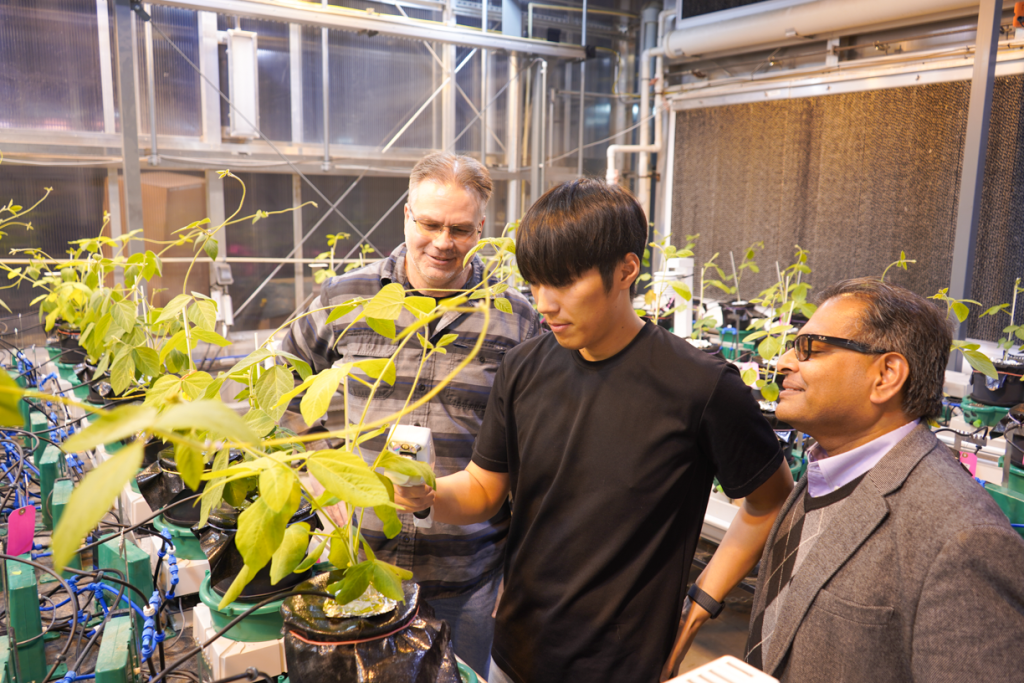
A major technological upgrade to the University of Missouri’s East Campus Plant Growth Facility is transforming how researchers study plant responses to environmental stress — particularly drought. Led by Felix Fritschi, the Alice C. Donaldson Professor in the Division of Plant Science and Technology, the new high-throughput phenotyping system offers unprecedented insights into plant growth and function.
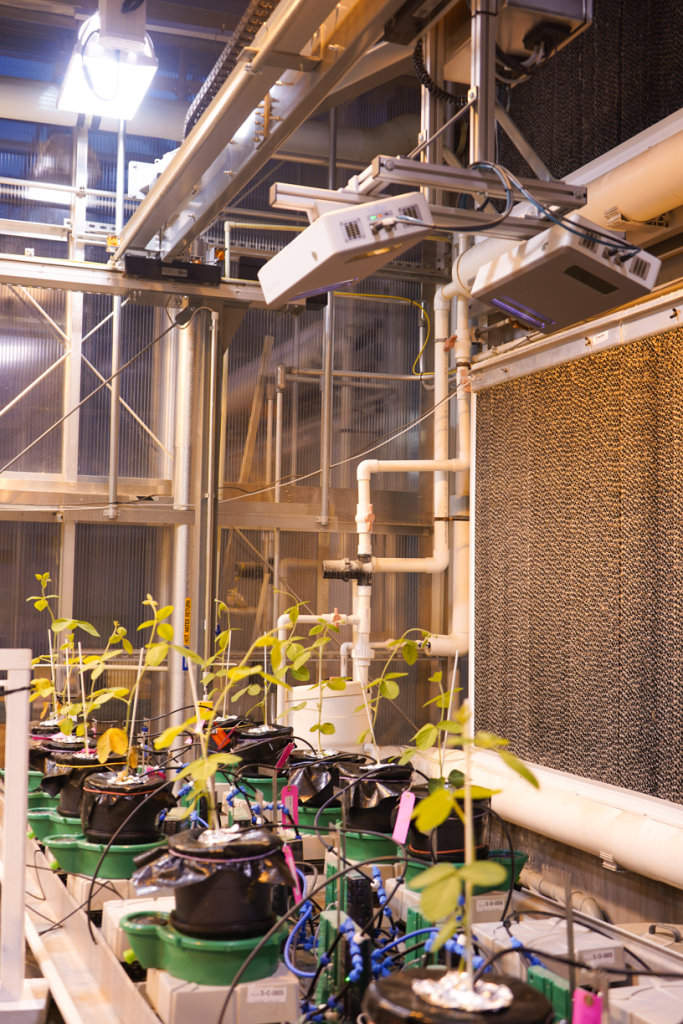
The new system combines two cutting-edge platforms that work in tandem: a network of automated scales — known scientifically as mini-lysimeters — and an overhead 3D scanning sensor mounted on a robotic support system. Together, they allow researchers to monitor and reconstruct plant growth in real time.
Each of the 200 plants in the greenhouse sits on an individual scale, which records weight changes every few minutes. The system’s software uses this data to automatically irrigate each plant based on user-defined protocols, enabling researchers to simulate various water-availability scenarios without manual intervention.
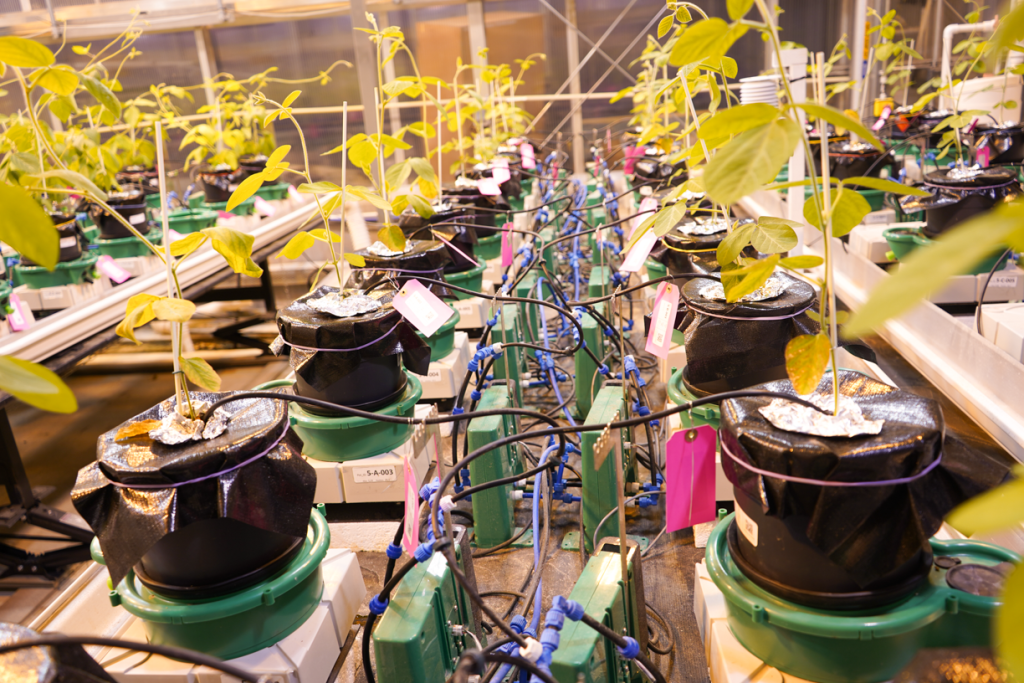
“This gives us high temporal resolution of plant water use,” Fritschi said. “We can observe how a plant regulates its water use minute by minute throughout the day. That’s critical for understanding mechanisms like stomatal regulation, which can change very rapidly.”
Above the plants, the scanner records 3D images and spectral data roughly once per hour, producing a virtual reconstruction of each plant. This not only captures changes in size and shape, but also measures 3D leaf area, and various canopy reflectance indices, such as greenness — all indicators of plant health and physiological status.
The combination of weight and imaging data allows researchers to characterize water consumption with visible growth patterns. Fritschi said the system opens new doors for improving crop drought tolerance by linking physiological and molecular traits to genetic differences.
The platform has already been tested on soybeans, but it is adaptable to a wide range of crop species important to Missouri, including wheat, corn, cotton, peanuts, sorghum and switchgrass. While smaller plants like Arabidopsis may require modifications, Fritschi said the system’s adjustable benches — custom-engineered in-house — help optimize scanning for both small and tall plants.
Use of the new technology is still in its early stages, with three experiments completed and more planned. Although Fritschi’s lab is currently the primary user, the facility was designed to serve a broader community of plant science researchers on campus.
“There’s a steep learning curve,” Fritschi said. “But once we’re fully operational, we expect it to be a valuable resource for many researchers.”
The system is also poised to be a rich training ground for students. A postdoctoral researcher is currently leading operations, supported by visiting scholars and undergraduate assistants. In total, three Mizzou undergraduates and seven visiting scholars are contributing to related projects this summer.
“This will absolutely have an educational component,” Fritschi said. “Grad students, postdocs, undergrads — they’re the ones doing the work and learning how to use this technology.”
The sheer volume of data being generated presents a new challenge — and opportunity — for collaboration with data scientists. With weight logs collected every few minutes and high-resolution scans produced multiple times a day, the system creates a massive dataset ripe for analysis.
Ultimately, the goal is to accelerate the development of more resilient crops that maintain stable yields under stressful growing conditions. For farmers, that could mean new plant varieties with better drought tolerance or more efficient fertilizer use — and fewer inputs lost to unpredictable weather.
“Everything we’re doing here is to better understand how plants function so we can make them more efficient, more resilient,” Fritschi said.
While the facility is not yet accepting outside research projects, Fritschi expects that to change in the future. Interested parties should contact him directly.
“This isn’t just for my lab,” he said. “It’s a collaborative resource that we hope will benefit the entire plant science community.”
The improvements were funded in a collective effort with contributions from Fritschi’s lab along with the CAFNR Office of Research; the lab of John Boyer, Distinguished Research Professor and National Academy of Sciences member (retired); the lab of Ron Mittler, Curators’ Distinguished Professor in the Division of Plant Science and Technology; the lab of Bob Sharp, Chancellor’s Professor and Curators’ Distinguished Professor in the Division of Plant Science and Technology; CAFNR’s Division of Plant Science and Technology and Mizzou’s Interdisciplinary Plant Group (IPG).