Each spring, the UM System’s Undergraduate Research Day is a chance for students across the university system to share their unique research with state lawmakers at the Capitol. But for Abigail Dowell, her research is more than an academic opportunity – it’s a gateway to her future.
Dowell is a post-baccalaureate senior studying animal sciences at the University of Missouri. She plans to attend the MU School of Veterinary Medicine in the fall but has taken a unique path to get to where she is today.
“I want to either go into general practice or into industry, like pharmaceutical or nutritional research,” she said.
Dowell earned her first two undergraduate degrees in chemistry and cognitive neuroscience from Washington University in St. Louis. What started out as a passion to pursue human medicine evolved into something slightly different.
“I started working with animals as a summer job at a boarding facility,” Dowell said. “I realized that animal medicine was a lot more exciting to me and that was what I wanted to pursue.”
Making this switch wasn’t as easy as Dowell originally thought. When she originally applied to veterinary school, she didn’t get in.
“I realized I needed more experience in animal science,” she said. “But there wasn’t an animal sciences program at my undergrad.”
That’s what led Dowell to pursue her third undergraduate degree at Mizzou. With the guidance of Amy Petry, an assistant professor in the Division of Animal Science, she quickly became involved in a research project that has changed what her future looks like.
Making every bite count: Improving efficiency in swine nutrition
Dowell’s research focuses on finding a way to more effectively feed pigs in the American pork industry.
“Since it’s such a huge industry, little improvements to efficiency can have a huge impact,” she said.
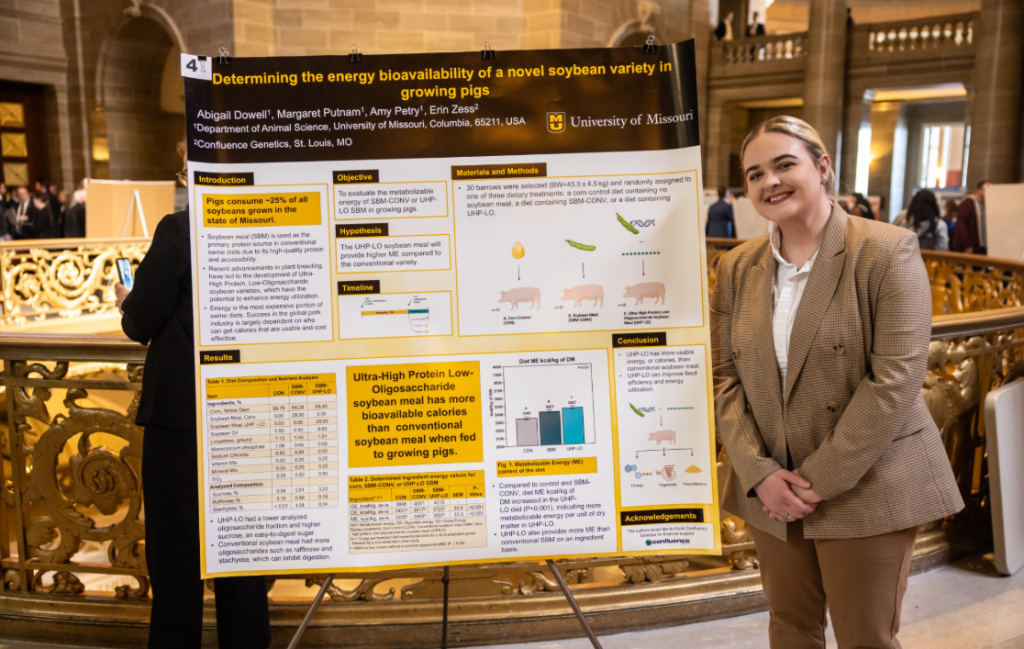
Working under Maggie Putnam, a graduate student, Dowell studied a type of soybean meal that has been developed through genetic selection. It has more calories and less anti-nutritional properties that inhibit digestion.
“If you can feed pigs less food with the same calories, that’s just more efficient for transport since you don’t have to transport as much food,” Dowell said. “It’s also better for the environment because the pigs aren’t excreting as much.”
Dowell worked with 30 castrated pigs, known as barrows, in a metabolism study. She analyzed them to figure out how much metabolizable energy was in the food they ate. That measurement represents how much energy the pigs could actually use, rather than the food’s gross energy.
“Gross energy is just all the energy that’s within a food, but it’s not very representative of what the animal can actually use,” she said. “For example, I could give you 100 protein shakes, but your body’s not going to be able to utilize all that protein.”
Dowell’s research found there was more metabolizable energy in the type of feed she studied. The results mean if pork producers begin to use this variety of food, there could be improved feed and cost efficiency in the industry.
“It really comes down to cost,” Dowell said. “That’s going to be the main thing that I think is going to get people on board.”
Sharing findings beyond the science community
Dowell said the biggest challenge of sharing her research at Undergraduate Research Day was learning how to speak to lawmakers.
“We had sessions beforehand where we talked about ways to talk to someone who has little to no background in science,” she said. “Ways to get them interested and understand why it matters.”
She described being both excited and nervous about the opportunity.
“People in the science industry, we all speak the same science talk,” she said. “I hadn’t really interacted with state representatives, so I was just nervous for that part it.”
Beyond sharing the impact of her research on the pork industry, Dowell said the research she’s done during her time at Mizzou has had a big impact on shaping her career goals.
“It’s so satisfying to help on an industry level and have these advancements that could change the world,” she said. “It sounds cliche, but these are things that could really change the way that people care for their animals.”