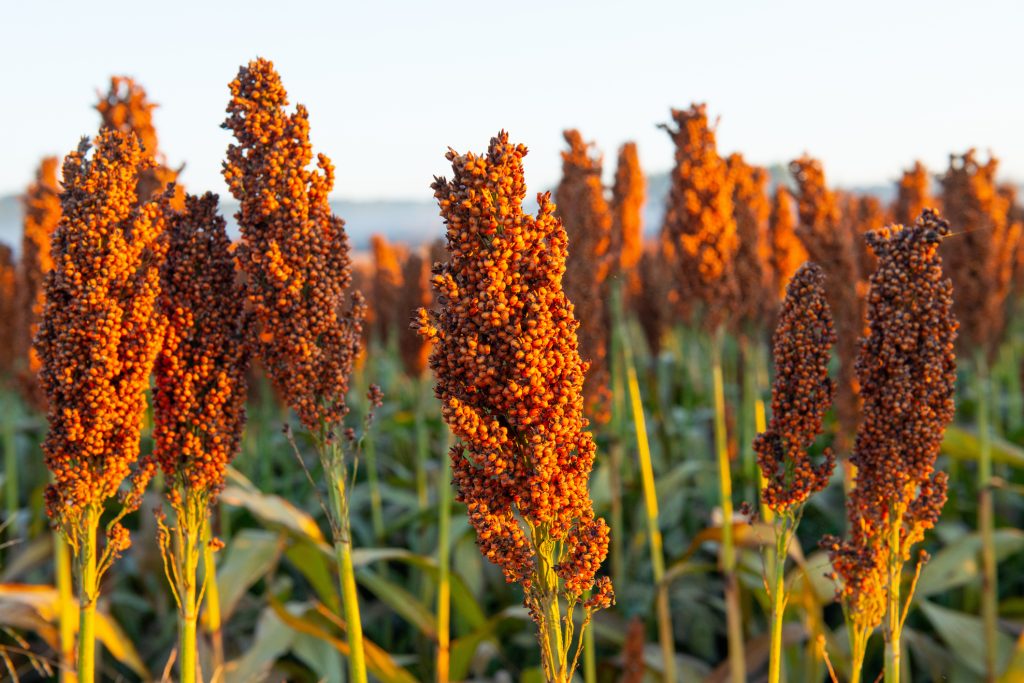
A new project funded by the U.S. Department of Energy (DOE) is bringing together top plant biology and AI experts from across the state to determine how sorghum – a promising candidate for bioenergy production – maximizes photosynthesis and sucrose transport in the challenging field conditions. Ultimately, this project aims to create plants more efficient in where they put their resources – and more profitable for producers.
The project, “Dissecting the Regulatory Mechanisms of C4 Photosynthesis and Carbon Partitioning in Sorghum,” is a five-year, $5.7-million grant led by Ru Zhang, associate member and principal investigator at the Donald Danforth Plant Science Center in St. Louis.
When the call for proposals came out, Zhang pulled together top experts for various segments of the research, which is using a systems approach. This means the team is tackling the research question from different methods to capitalize on potential answers of which genes, proteins or processes can maximize photosynthesis in sorghum, and then employing AI and machine learning to integrate data and narrow down predictions before testing.
She didn’t have to look far to assemble the team, making collaboration simple yet powerful. Many of those top experts were less than a two-hour drive from the Danforth Center; most had collaborated before or at least had known each other professionally.
Mizzou collaborators are David Braun, professor in the Division of Plant Science and Technology in the College of Agriculture, Food and Natural Resources and in the Division of Biological Sciences in the College of Arts and Science; and Jianlin (Jack) Cheng, Curators’ Distinguished Professor and Paul K. and Diane Shumaker Professor in Bioinformatics, College of Engineering. Additional collaborators hail from Danforth, Washington University in St. Louis, and the California Institute of Technology.
“This project provides a great opportunity to collaborate with great scientists from multiple disciplines to tackle a significant scientific problem,” Cheng said. “The strong interdisciplinary collaboration between the researchers from the four institutes is the key for the success of this project.”
“Plant sciences is an outstanding collaborative environment. I’m ecstatic to build on that,” said Braun, who is also the director of Mizzou’s Interdisciplinary Plant Group (IPG).
Braun’s lab specializes in identifying genes that control carbohydrate partitioning. They have mainly explored this idea in maize, although sorghum has also been part of their research program – the two plants are genetically very similar and so Braun and his team can leverage discoveries from one to the other fairly easily, he said.
Carbohydrate partitioning in plants is a process that involves the distribution of carbon taken in through photosynthesis – which is ultimately converted to sucrose. The different angles scientists will examine also include physiology related to sugar transport in the canopy leaves from different levels; omics to investigate RNAs, proteins and metabolites to understand how plants convert sunlight into energy and sugar in the different leaf levels; and the photosynthetic process – studying protein involved in light harvesting.
The overall goal of the research is to understand how sorghum tolerates very high levels of light stress, high temperatures and other environmental stresses in the field. Sorghum uses a specialized and efficient process, C4 photosynthesis, an adaptation that minimizes water loss in intense sunlight and heat. Photosynthesis, the process plants use to convert sunlight and carbon dioxide into sugar, is the key driving force for food and bioenergy production; however, the regulation of photosynthesis remain elusive, especially under stressful conditions in the field.

“We’re going to understand how the plants maximize sucrose transport and what are the bottlenecks that occur,” Braun said. “Plants in a field situation deal with shading and competition for resources; leaves at the top get more sun and have very different rates of photosynthesis. So, we’re looking to understand different photosynthesis rates at different levels in the canopy and come up with engineering strategies to overcome the bottlenecks in sucrose transport to increase productivity overall.”
The field work will be done at Danforth’s Field Research Site in St. Charles and each lab will run tests based on their area of expertise once the plants are harvested. Then, Cheng will take all data collected and use AI/machine learning to look for highlights. Ultimately, genetically modified plants will be tested to see if the findings translate to real-world conditions.
Cheng said he is eager to develop new machine learning/AI methods for this project, leveraging extensive experience integrating multimodal biological data through machine learning and AI. The work will reconstruct gene regulatory networks underlying photosynthesis and carbon partitioning.
“We also aim to predict the function, structure and interaction of key proteins involved in the regulation process,” Cheng said. “AI will be used to generate predictions for our collaborators to test in the laboratory or field. The feedback will be used to further refine the modeling and prediction.”
Currently, the team is meeting monthly to plan the summer growing season, Braun said.
“This foundational research will ultimately generate key knowledge to lend itself toward improved sorghum varieties. Research has never been conducted before at this depth for this question,” Braun said.