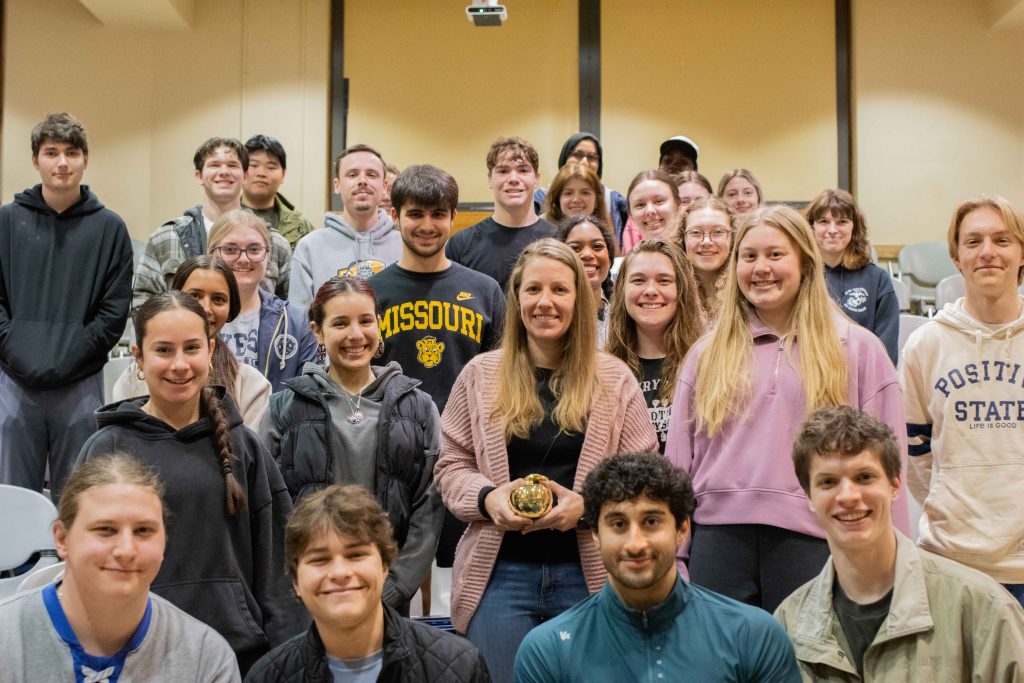
Stephanie Gates, an assistant professor in CAFNR’s Division of Biochemistry, received the Golden Apple Award Wednesday, March 4. The award is a recognition of her excellence in attention to student learning.
Gates received the award while teaching BIOCHM 2112: Biotechnology in Society. She was surprised with the award by Bryan Garton, senior associate dean and director of academic programs, and several other colleagues.
Professors who are eligible for the Golden Apple Award must exhibit clarity, variability and enthusiasm in their instruction. Faculty must be accessible to students, helpful, personable and act as a mentor. They should provide multiple opportunities to learn and clearly establish objectives and expectations.
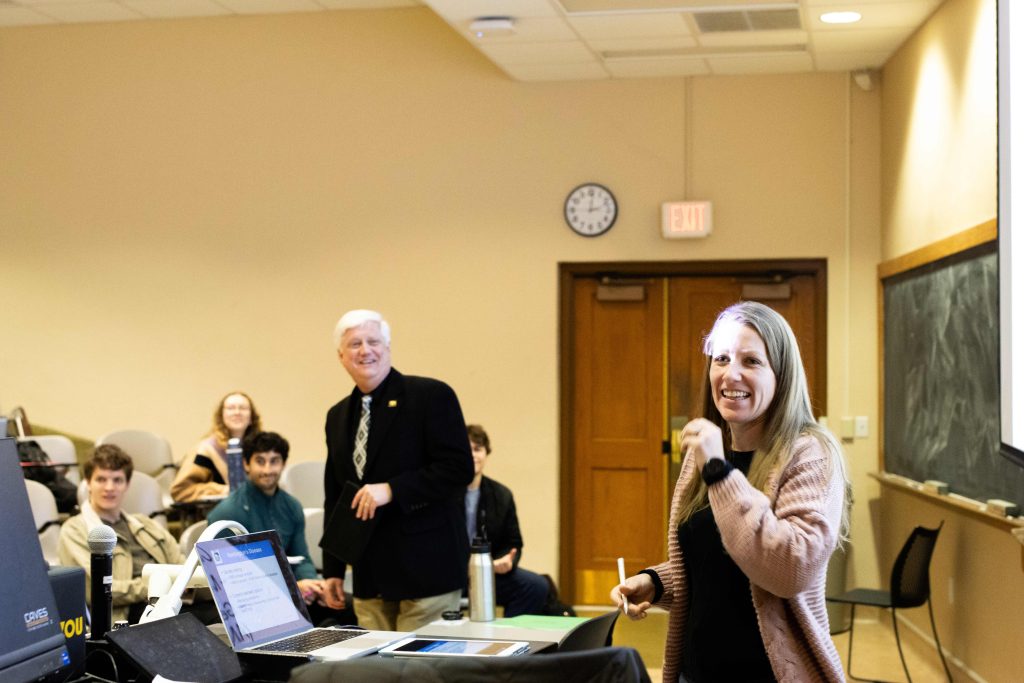
Michael Chapman, director of the Division of Biochemistry and Gates’s nominator, said her excellent teaching qualities are evident among her peers and students.
“Peer observation and student evidence present a teacher who is well prepared, responsive and consistently focused on creating meaningful opportunities for learning,” he said.
Many students provide strong feedback indicating Gates is organized, gives helpful feedback and encourages creative thinking. Gates uses group activities, guided discussion and in-class polling to identify where students are less confident so she can adjust the course’s pace accordingly.
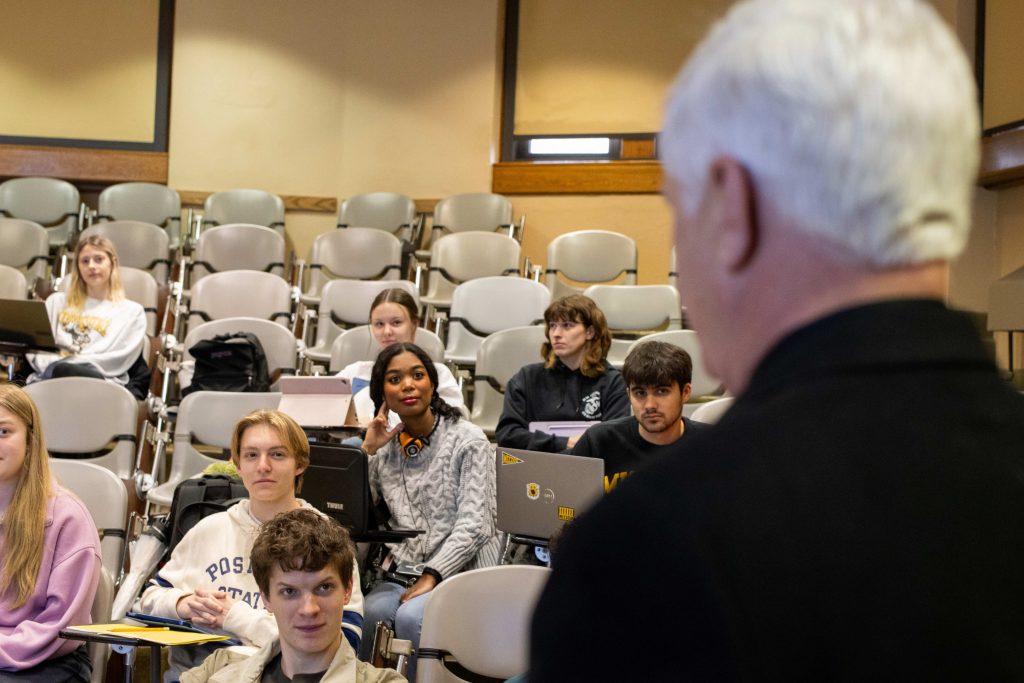
Chapman said Gates is consistently focused on creating meaningful opportunities for learning and stays flexible in lesson planning.
“When students struggled with a worksheet, she paused the planned progression of the lecture to reframe the task and model the first steps – demonstrating a teaching style that prioritizes understanding over coverage,” he said.
Student ratings across four course offerings are particularly strong for Gates’s skills in encouraging participation, facilitating discussion and supporting cognitive engagement through problem solving and application to real-world contexts.
Shari Freyermuth, an associate teaching professor emerita in Biochemistry, said Gates’s enthusiasm is visible in her teaching.
“Dr. Gates is clearly interested in what she is teaching and understands the importance of non-science majors having an understanding of science in everyday life,” she said.
Gates works with research scientists and students in the University of Missouri’s Gates Lab on Protein Quality Control (PQC) research. PQC is important for cellular function and implicated in human diseases, including cancer and neurodegeneration.
“Her ability to teach well while actively engaging in research and mentoring is quite an accomplishment,” Freyermuth said. “The Biochemistry department is lucky to have her.”