In the spirit of service that was the cornerstone of the University of Missouri’s founding in 1839, the Mizzou Alumni Association Student Board presents the Mizzou ‘39 Award to 39 outstanding seniors each year.
The honorees are chosen for their academic achievement, leadership and service to Mizzou. They represent a variety of majors, activities and organizations from across campus.
Each recipient also chooses a faculty or staff member to recognize as their adviser throughout their college career.
This year, three CAFNR students won the award. Read more about who they are, their achievements and future plans below.
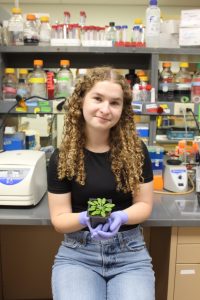
Carissa Bersche
Carissa Bersche is a senior graduating with a degree in biochemistry. She plans to pursue a PhD in plant molecular biology and aims to have a career in research.
“I started doing science fairs in kindergarten, and I did a lot of plant projects,” she said. “I was always very interested in plants.”
Research has always been a big part of Bersche’s life. She built the foundation for her career in elementary school.
“When I went to my first conference, it was at Washington University when I was 11,” she said. “I’ve known for a long time that this is what I’ve wanted to do.”
Bersche chose the University of Missouri because of a program called Freshman Research in Plants (FRIPS). It’s a program funded by the U.S. National Science Foundation (NSF) that immediately puts freshmen in research labs once they arrive on campus.
“Since I knew I wanted to do plant science research and get involved right away, this was the perfect program,” she said.
Bersche has worked in a lab run by Antje Heese, an associate professor emerita in the Department of Biochemistry. Bersche also chose Heese as her mentor.
“It was really meaningful because my mentor is retiring this year, and I was her first Mizzou 39 recipient,” she said. “It was very exciting to acknowledge her efforts.”
Bersche has been studying vesicular trafficking and plant immunity, which provides crucial information to understand disease resistance and improve crop yields.
“My work studies how plants transport materials in the cell so that they can have the correct response,” Bersche said.
Bersche has completed summer research internships at Duke University and the University of Wisconsin–Madison, which she considers some of the best and most unique opportunities she’s received.
“They exposed me to different plant science researchers, so I was able to expand my network and start projects in a new lab within a short period of time,” she said.
Bersche is also an undergraduate research ambassador for Mizzou and served as the president of the Biochemistry Club for two years. She credits CAFNR with preparing her for the next step in her career, which is attending graduate school.
“CAFNR has been the best part of my college experience,” Bersche said. “It has really prepared me to conduct research, be a successful student and be a good leader and communicator.”
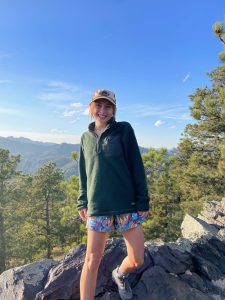
Emma Knudson
Emma Knudson is a senior graduating with a degree in environmental sciences with an emphasis in education and outreach. She has accepted a job offer to work as a soil scientist and urban specialist.
“It’s a lucky combination of the two things that I love,” she said. “I’ll be doing a combination of soil analyses for soil conservation and engaging directly with urban landowners by doing outreach events.”
Knudson realized she had a love for soil through the knowledge she gained in her classes. She also joined Mizzou’s soil judging team, which she said changed her whole perspective.
“I was like, ‘Wow, I could do this for the rest of my life,’” she said. “I have so much fun.”
Knudson chose Kerry Clark, a coach of Mizzou’s soil judging team and an associate research professor in the School of Natural Resources, as her mentor.
“I chose her because she’s just the epitome of the type of educator and leader that I want to be someday,” she said.
As a new student, Knudson joined the Freshman Research in Plants (FRIPS) program and worked in a soil biochemistry lab for two years.
“It was clarifying for me though,” she said. “I realized that I didn’t know if I wanted to be in a lab coat all day by myself. I loved the work, but it was very isolating.”
Originally pursuing environmental sciences with an emphasis in land and soil, Knudson’s research experience opened her eyes to another career path: Educating others about the environment.
“I then started a new job in education through the College of Education in a curriculum-based development lab,” she said.
Knudson helped write energy literacy curriculum and was also a Hollings Scholar through the National Oceanic and Atmospheric Administration (NOAA). That came with the opportunity to complete a 10-week research internship in coastal Maine.
“I got to present that research not only in Marlyand with the NOAA Hollings cohort, but also in New Orleans at the American Geophysical Union Conference in December,” Knudson said.
She said the best part of her undergraduate experience has been the freedom to explore.
“It’s been a lot of fun trying new things, and I mean, that’s the great thing,” Knudson said. “You have the time to try different options, be in different labs, try different projects.”
Looking back at the past four years, Knudson wishes she could give advice to her freshman-year self.
“I would shake her by the shoulders and tell her to stop being so afraid of everything,” she said. “I’d tell myself that it’s okay to try something and then change your mind and try something new.”
Knudson said being a Mizzou ‘39 recipient is extremely special to her because of how much she’s grown.
“Freshman year me is a mile away from this kind of stuff,” she said. “It took me a while to break out of my shell when I was here, and that’s why I think this honor means so much to me.”
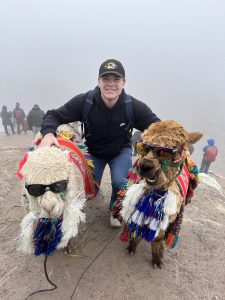
Harrison Luechtefeld
Harrison Luechtefeld is a senior graduating with degrees in biochemistry and economics.
“I’ve been able to learn so much about the healthcare system by combining both of those degrees,” Luechtefeld said. “Just as far as resource allocation and management goes in the healthcare system, it’s super crucial.”
He works at University Hospital as a Care Team Associate (CTA) in the oncology department. He said his two areas of study have helped him with his job.
“Seeing what we do in class and being able to apply that in the hospital and when I do research, it’s super incredible to see just how impactful money can be in the healthcare system,” he said.
Luechtefeld plans to attend medical school and currently has an interest in working in pulmonology or Intensive Care Units (ICUs).
“Those patients are in their most vulnerable stages of life,” he said. “I want to be there for them at that stage.”
Luechtefeld said he chose biochemistry to have the best of both worlds in preparation for medical school.
“People who are biochem majors tend to do better on the MCAT,” he said. “It prepares you a little bit better because you get that emphasis on both chemistry and biology.”
Luechtefeld chose Jalen McGregor, a pre-health professions advisor in Mizzou’s MedOpp Advising Office, as his mentor.
“I turned and confided in Jalen, and her input is probably the reason I’m still here right now,” he said.
His experience in CAFNR has been formative to shaping who he is today, both in and out of the classroom.
“A lot of the hands-on experience was really impactful for my education,” Luechtefeld said. “Every step of my degree, I felt like I had someone by my side.”
Luechtefeld’s involvement in Mizzou’s chapter of Global Medical Training (GMT) has also been a key part of his undergraduate experience.
“Being in the field with other students and even leading a couple of the trips was one of the most incredible experiences I’ve had at the University of Missouri,” he said.
His advice for future students is to get involved in something that allows you to leave your legacy on campus.
“Get involved a lot early on,” he said. “Not all of the organizations that you’ll find you will have a really strong passion for, but the ones that you do stick with, you become an integral part of that organization and help it grow.”