American prairies are vanishing. But University of Missouri senior Ryn Kreitz wants to change that. As an undergraduate researcher, Kreitz is gathering data in a project that aims to better inform prairie restoration plantings.
“In most states which had contained prairie, there’s only, like, less than 1% of what had originally been there,” Kreitz said.
The golden, grassy expanses that are a key characteristic of the American landscape are more endangered than the Amazon rainforest.
“They’re one of the most endangered ecosystems in the world, which you wouldn’t think of,” Kreitz said. “In Missouri, we have 99.9% eradication of prairie.”
The disappearance of this ecosystem is a phenomenon that Kreitz is determined to change.
“It’s a huge problem, which is why I want to get in there,” they said.
Planting the seeds for success
Kreitz is studying plant sciences, with an emphasis in breeding, biology and biotechnology.
“I’ve always loved nature,” they said. “It is at the heart of my life.”
What started as interest in becoming a botanist evolved into specializing in their field of study.
“It’s really exciting to say, ‘This is my thing,” Kreitz said.
A major influence in Kreitz’s chosen career path has been Mizzou’s Finke Insect Ecology Lab. When Kreitz began working there, it changed their world.
“I was enthralled,” they said. “It took me away.”
Kreitz said their experiences in the lab and in entomology class opened their eyes to new opportunities in the academic field.
“Being in a class with someone who is an ecologist and studies insects and plants, it’s everything I never knew I wanted,” they said.
Research to promote prairie reconstruction
Kreitz now conducts research under Debbie Finke in the Finke Insect Ecology Lab. It’s an opportunity made possible by the McNair Scholars Program, which gives eligible students experiences that prepare them for doctoral study. Kreitz was selected as a McNair scholar in May 2025.
“There are a lot of applicants for this program, and I was accepted,” they said. “And I think all the time about how that’s crazy.”
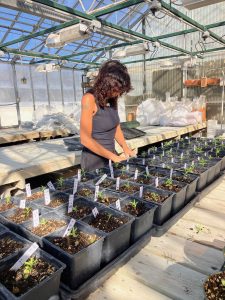
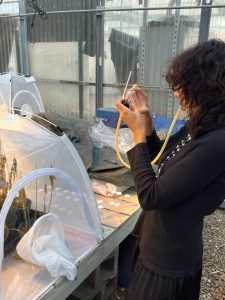
Kreitz’s research experiment investigates how plants and insects respond to different soils. They analyze how conventional versus conservative agricultural practices impact the soil and the native plants and insects living in it.
“I’m looking at how that impacts native plants, as well as the insects that live on them and their predators,” Kreitz said.
Each soil sample Kreitz collects is used to create a small system of native plants, aphids and wasps in a greenhouse on campus.
“What does this plant look like when it’s in this soil? How are the aphids doing? How are the wasps doing? How does it all differ?” Kreitz said.
One goal of Kreitz’s research is to better inform farmers who are interested in the Conservation Reserve Program (CRP).
“It’s a program where farmers are incentivized to hand over their land and plant native plants there instead,” they said. “It acts as a makeshift sort of prairie habitat for pollinators, for ecosystem services, for wildlife.”
Once Kreitz concludes their research, they hope to attend graduate school and continue studying insect ecology. It’s a goal that’s shaping Kreitz’s future, thanks to the research opportunities at Mizzou.
“Every time I call myself an undergraduate researcher, it feels so good,” they said. “It has just changed my life. The program, the lab, the research. All of it.”