PART IV: How Generative AI is Transforming Natural Resource Stewardship
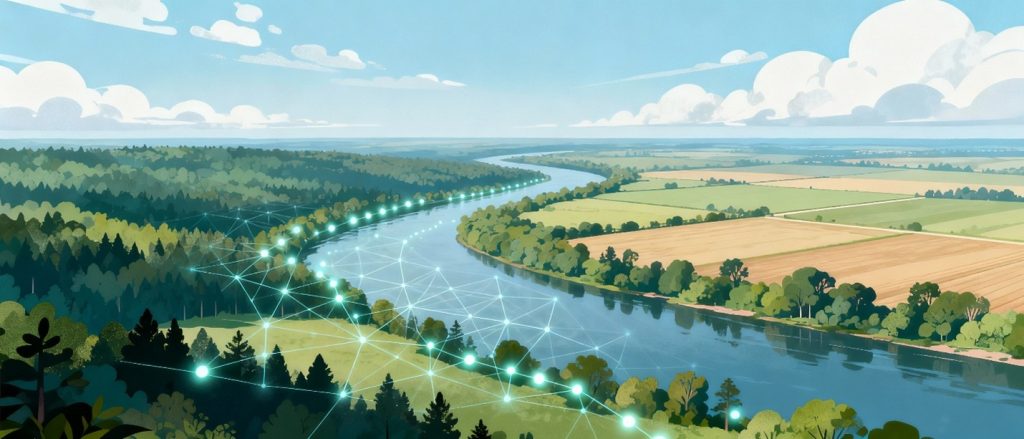
Generative AI has emerged as a powerful partner for scientists, land managers, and communities working to understand and protect natural resources in our state and around the world. From modeling climate-driven risks to guiding conservation investments, these tools help transform overwhelming amounts of data into clearer options for action.
Key Questions
- How can AI help monitor and manage complex ecosystems more effectively?
- What role does AI play in modeling climate patterns?
- How can AI support sustainable conservation and land-use decisions?
- What guardrails are needed to ensure AI use is ethical, transparent, and trusted?
Seeing the Invisible: AI for Ecosystem Monitoring
Modern ecosystems generate a flood of information, from satellite images and drone surveys to in-stream sensors and camera traps. Generative AI tools can combine these data to flag changes in vegetation, water quality, or wildlife activity that signal emerging problems (e.g., invasive species, drought stress, or habitat loss). Techniques like those used for movement analysis in exercise science can be adapted to track landscape “movement,” like shifting river channels or forest edges, in near real time, helping agencies prioritize where to restore wetlands, which forests are most vulnerable to pests, and how to best manage prescribed fires while protecting biodiversity. Work at MU’s College of Agriculture, Food and Natural Resources already uses advanced sensing and modeling to guide decisions about trees, soils, wind, and water on working landscapes, and AI can further accelerate and refine these efforts by turning raw data into timely, decision-ready signals about ecosystem health.
Key Point: AI turns raw data into timely, decision-ready signals about ecosystem health.
Modeling Climate Futures for Missouri and Beyond
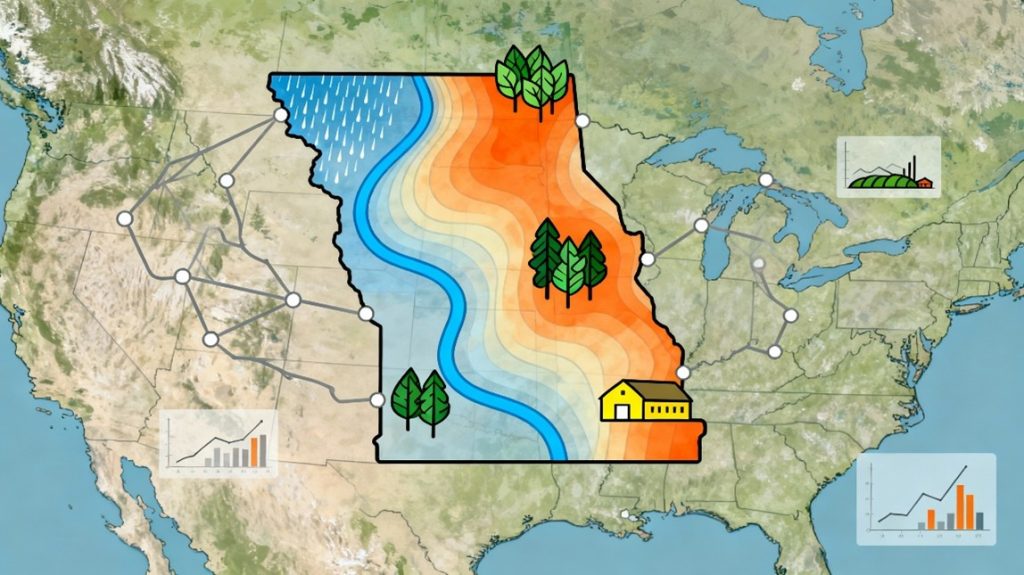
Evolving climate patterns are affecting rainfall, heat waves, and flood risk across North America, with major implications for agriculture, forests, and rivers. Generative AI can help researchers explore what-if futures by learning from historical climate and land-use data, then generating localized scenarios that show how different management choices might play out under hotter summers, more intense storms, or prolonged droughts.
Key Point: Generative AI helps translate global climate projections into locally relevant scenarios that support more resilient natural resource planning.
From Lab to Land: Applications at Mizzou
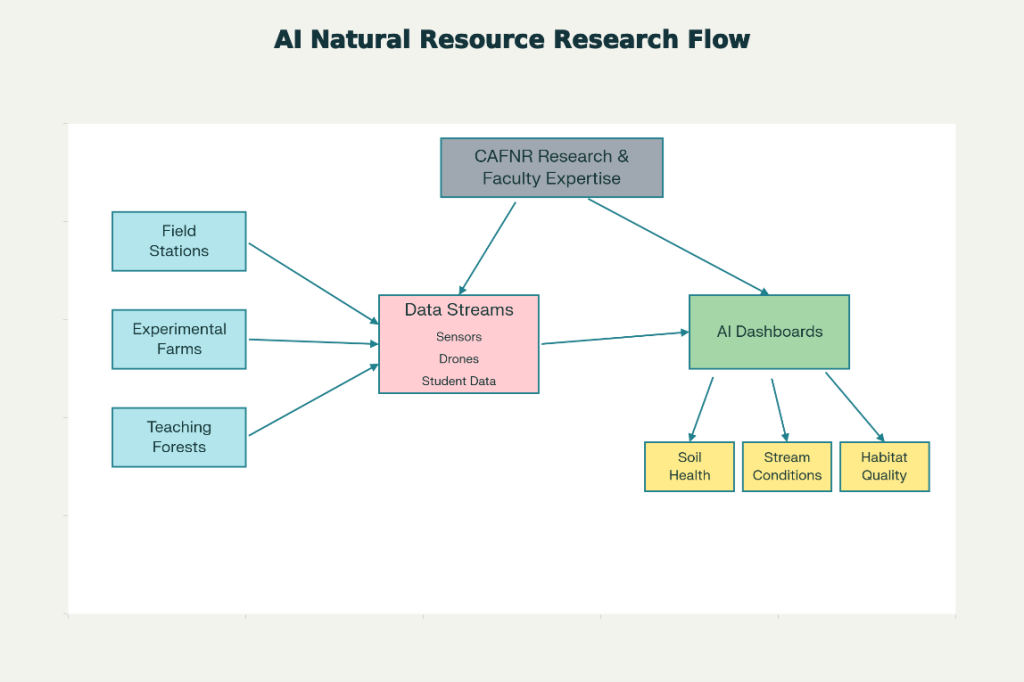
Within CAFNR, the same AI capabilities that support sports biomechanics and personalized nutrition can be repurposed to understand how landscapes move and change. Field stations, experimental farms, and teaching forests can use AI to integrate sensor networks, drone imagery, and student-collected data into dashboards of soil health, stream conditions, and habitat quality.
As a national leader in agricultural and natural resource research, CAFNR hosts faculty who apply advanced modeling and remote sensing to questions ranging from watershed management to sustainable forestry and agroforestry. Their work provides a natural home for generative AI experiments, for example, simulating how different land-use or management scenarios might affect water quality in Missouri streams, wildlife habitat in forested watersheds, or carbon storage in agroforestry systems.
Key Point: Mizzou and CAFNR serve as real-world testbeds where AI-enhanced ecosystem models inform both research and on-the-ground management.
Ethics and Trust in AI for Nature
Decisions about land, water, and ecosystems must account for justice and the needs of the most vulnerable, so when AI informs land-use planning or water management it is essential to ask whose data are used, whose priorities shape the models, and who benefits from the results. Responsible AI in natural resources means being transparent about model limits, checking for biases that could disadvantage communities or ecosystems, and treating AI outputs as tools to support, rather than replace, local expertise and decision-making.
Key Point: AI should amplify, not override, local knowledge when shaping decisions about land, water, and wildlife.
Takeaway
Generative AI is becoming a new co-manager for natural resources at Mizzou and beyond, helping researchers and practitioners turn complex environmental data into insight and action. Used thoughtfully, it can strengthen ecosystem monitoring, sharpen climate resilience planning, and support more transparent conservation decisions in Missouri and across the globe.
References and Useful Resources
- College of Agriculture, Food and Natural Resources, University of Missouri. Innovative research in agriculture and natural resources.
- School of Natural Resources
- School of Natural Resources Research
- CAFNR Research Enterprise: A Healthier Environment
- U.S. Department of Agriculture, Forestry Service: Landscape Change Monitoring System (LCMS) | US Forest Service Research and Development
- Alotaibi & Nassif. (2024). Artificial intelligence in environmental monitoring: in-depth analysis. Discov. Artif. Intell. doi.org/10.1007/s44163-024-00198-1.
- Biazar et al. (2025). Artificial Intelligence in Hydrology: Advancements in Soil, Water Resource Management, and Sustainable Development. Sustainability. https://doi.org/10.3390/su17052250.
- Karasaki et al. (2024) Machine learning for environmental justice: Dissecting an algorithmic approach to predict drinking water quality in California. The Science of the total environment. 10.1016/j.scitotenv.2024.175730
Produced by:
Daniel Credeur, PhD
Associate Teaching Professor in Food, Nutrition, and Exercise Sciences
Provost’s AI Fellow for CAFNR