Katherine Spitzmiller’s love for science began long before she became a student at the University of Missouri.
“I’ve always been super interested in chemistry, health and how the body works in general, so I thought I’d bring those two together,” she said.
Now a junior studying biochemistry, Spitzmiller’s passions have led her to work in a lab run by Chung-Ho Lin, a research professor in the School of Natural Resources. She currently conducts research on the relationship between American elderberries and influenza.
“People have been taking American elderberry extract for centuries,” she said. “Our goal is to find out how they’re working against the flu, and also which compounds are actually doing the work, so I test those individually.”
Spitzmiller presented her research poster on this topic at Show Me Research Week April 21. The event is a celebration and showcase of undergraduates, graduate students and postdoctoral fellows involved in research.
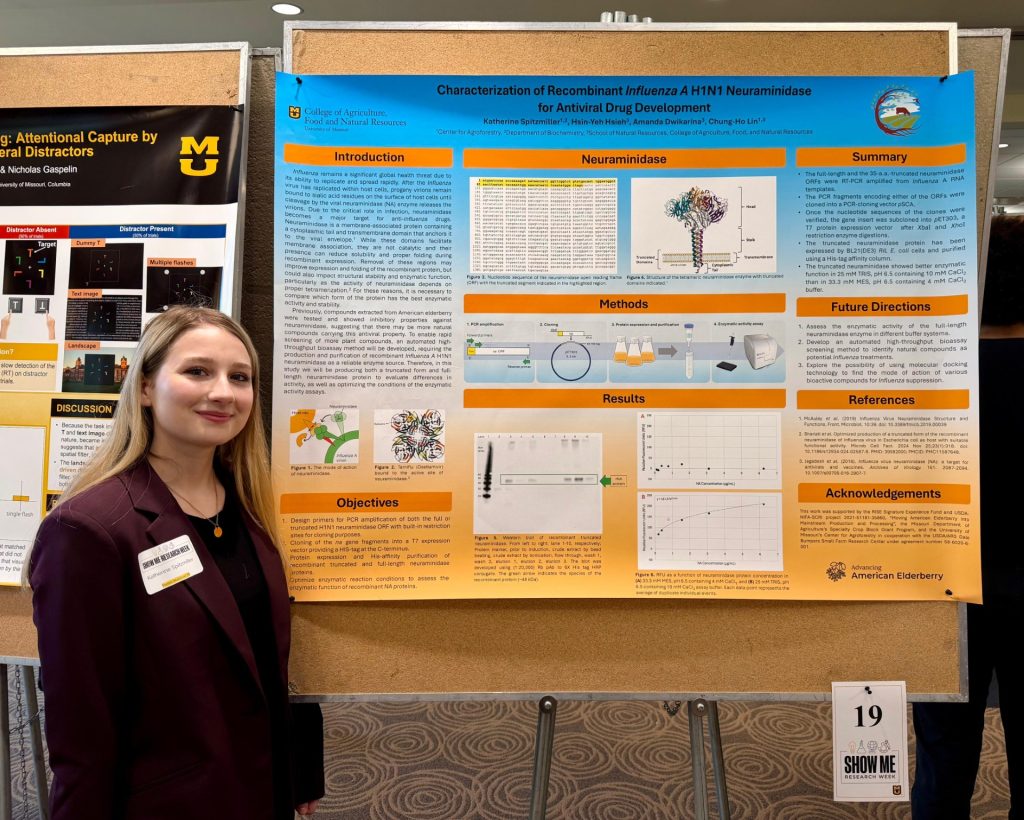
Research with the potential to revolutionize industries
Spitzmiller’s discoveries have the potential to impact growers and consumers across the state and country. Part of her research involves educating others on the differences between American and European elderberry.
“European elderberry is what’s in stores sold as supplements,” Spitzmiller explained. “But American elderberry is actually native to Missouri, and it has these health-promoting compounds that are really good for you.”
Spitzmiller said the reason American elderberry isn’t as common in the health supplement market is because there aren’t enough producers growing it.
“We have to have growers who want to produce it, and that’s just really rare around here,” she said. “One goal we have is to push farmers to produce more of these specialty crops.”
Spitzmiller said she’s already seen the impacts of her research when it comes to educating people in the agriculture industry –especially during her experience presenting at the American Elderberry Association in June 2025.
“The farmers there were like, ‘Oh my gosh, I’m going to grow more now,’” she said.
Beyond farmers, Spitzmiller also said she enjoys the general public’s reaction to her research. This was especially apparent during her experience presenting at Undergraduate Research Day at the State Capitol March 12.
“One thing people pretty much always come up and say is, ‘I’ve been drinking the tea,’ or ‘I’ve been taking these supplements,’” she said. “They always say it’s good to find out that it could actually be doing something.”
Overcoming obstacles and looking forward to future research
Spitzmiller’s role in expanding knowledge about the American elderberry hasn’t come without challenges. She explained that her biggest barrier to overcome has been trying to find ways to make her research approachable and fun.
“You can tell when you’re talking and somebody’s getting bored,” she said. “It’s been important just trying to get people excited about the project in general.”
Although she’s already seen significant success with her current findings, Spitzmiller is looking forward to expanding her research throughout the rest of her time at Mizzou.
“We’re planning to test different compounds from the elderberry in different combinations, kind of like an elderberry cocktail,” she said. “This will help us see which could work even better than the single compounds alone.”
Spitzmiller also plans to expand the research in another direction that could help innovate the American elderberry and health supplement industry.
“Something else that we’re looking forward to is testing the juices from different cultivars throughout Missouri to see if maybe one grown in a certain region has better effects than others,” she said. “I’m super interested to find that out.”
Without her research experience, Spitzmiller said she wouldn’t be where she is today.
“I’d definitely be struggling more in my classes because a lot of the hands-on concepts that I do in the lab, they apply to my courses,” she said. “It can really benefit any aspect of your life.”