Skip Navigation
Future Students   |   Current Students   |   Alumni   |   Community & Friends
Home  |  A-Z Index

Research

Research, teaching and outreach from the College of Agriculture, Food and Natural Resources has an impact that is worldwide.

From breakthrough research using a DNA screening test to more rapidly detect a disease affecting Old Order Mennonites in Missouri to new developments in wheat genetics making the crop more tolerant to the high-aluminum soils found in many developing countries, our work spans the globe.

Featured Research

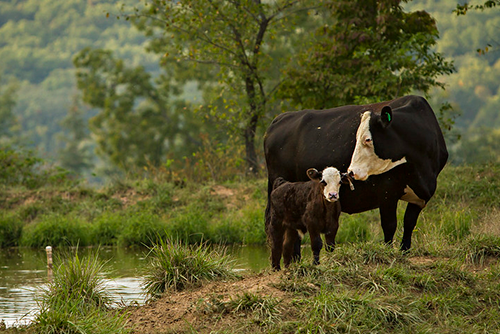
Kiwi DairyDairy farmers find more green in grass

Some New Zealand immigrants in Missouri are working to persuade American dairy farmers that changing the way they feed their cows could save money in the long run. Maureen McCollum reports. Hear the story on NPR.


UraniumGreen wood: CAFNR professor Francisco Aguilar researches environmentally certified forest products

How much more will the average consumer pay to help the environment? Francisco Aguilar, assistant professor in forestry at the University of Missouri College of Agriculture, Food and Natural Resources, is learning what consumers are willing to spend on environmentally certified wood and paper products. More


UraniumStinky little uranium traps: Sulfate-reducing bacteria smell terrible but can make radioactive toxins less harmful

Judy Wall, a professor of biochemistry at the University of Missouri College of Agriculture, Food and Natural Resources, is working on an alternative way to clean up contaminated areas using bacteria to reduce toxic metals to inert substances. More


Nepali fish famersLives of Nepal's fish farmers improved with help from an MU professor, science and vertical cages

Today, the Nepal interior economy is thriving because of a small, but significant, change in production technique. Families not only have food, but a surplus to sell for cash. Tourists flock to the area to sample the catch, bringing in more money. All that was needed was a little science from a University of Missouri aquatic ecologist. More


PlanetKeeping Our Big Blue Planet Green

The Department of Forestry monitors how trees are working naturally to balance carbon and water in Missouri's Ozarks as part of a coordinated network created to monitor and address scientific uncertainties associated with global climate change. More


Bob SitesThe Bug Collector

CAFNR researcher documents life in a disappearing ecosystem. Where the insects go, Bob Sites goes. More


CancerWhen It Comes to Understanding Cancer, 14 Heads are Better than One

From cell growth and basic biochemical interactions research to diagnosing skin cancer using laser-induced ultrasound, researchers in the College of Agriculture, Food and Natural Resources are attacking cancer from 14 different perspectives. More


MU Biological Engineers build capillary-sized laboratories.MU Biological Engineers Build Capillary-Sized Laboratories

MU researchers are taking major strides toward the development of tiny, highly efficient liquid-core optical ring resonators (LCORR), or "lab-on-a-chip" sensors, which can perform multiple analyses at a high rate of speed with samples as small as a picoliter, or one-trillionth of a liter. More


MU Entomologist Finds Host of New Aquatic Insect Species in ThailandMU Entomologist Finds Host of New Aquatic Insect Species in Thailand

MU Entomologist Robert Sites discovers more than 50 new insect species in Thailand, some of which even eat small fish. More


MU assistant professor of biological engineering John Viator uses a method called photoacoustic detection, which combines laser and ultrasound techniques, to speed melanoma diagnosis.MU Researcher Uses Sound to Detect Skin Cancer

MU assistant professor of biological engineering John Viator uses a method called photoacoustic detection, which combines laser and ultrasound techniques, to speed melanoma diagnosis.

   Hearing cancer (WMV)

More


Boaters on Missouri rivers have been ducking these flying Asian carp to avoid serious injury from the huge fish as they launch themselves into the air. MU's researchers have applied creative thinking to this problem.Bad Fish to Good Food

Boaters on Missouri rivers have been ducking these "flying" Asian carp to avoid serious injury from the huge fish. MU's researchers have applied creative thinking to this problem.

  Flying carp may jump onto zoo menus (WMV)

More


CAFNR is working with the campus' power plant to determine if using discarded corn cobs mixed with coal is a viable method to reduce fuel costs while helping to keep the pollution in the skies to a minimum.Guess What's Powering Mizzou?

CAFNR is working with the campus' power plant to determine if using discarded corn cobs mixed with coal is a viable method to reduce fuel costs while helping to keep the pollution in the skies to a minimum.

   Guess what's powering Mizzou? (WMV)

More


Adult pig stem cells were successfully directed to become neurons, which are found in the brain and spinal cord.  These particular pig cells are unique because the pigs also contained a gene that makes their cells fluorescent.MU Researchers Grow Neural Cells from Adult Stem Cells

Adult pig stem cells were successfully directed to become neurons. These particular pig cells are unique because the pigs also contained a gene that makes their cells fluorescent.

  MU researchers make stem cell discovery (WMV)

More


Additional Research Features

Read about the dangers of synthetic turf, pigs that produce their own omega-3 fatty acids and final reports for the six-state animal waste management consortium. More Research Features

Back to Top

Revised: October 22 2009
Copyright © 2009 — Curators of the University of Missouri. DMCA and other copyright information. All rights reserved.
Published by CAFNR Communications