|
CAFNR Office of Research Newsletter // May 29, 2025 // 7(11) |
|
Feature Story |
|
|
Plant sciences student presents innovative research at Undergraduate Research Day at the Missouri State Capitol »
|
|
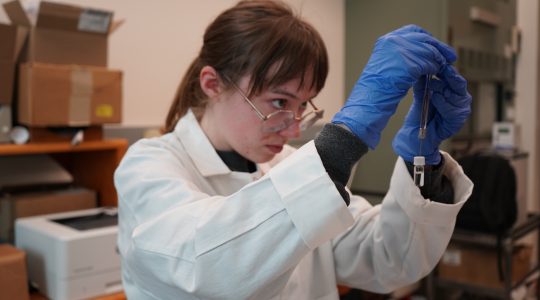
Ruth Williamson, a senior in plant sciences (breeding, biology and biotechnology emphasis) presented her research on the benefits of being outside on human health. When Ruth Williamson came to Mizzou from Raytown, Missouri, she knew she wanted to at least try undergraduate research. She was passionate about environmental sciences, but wanted to get a deeper understanding of one of the most important parts of our environment: plants. Soon after her freshman year began, Williamson was accepted to the Pre-MARC program (Maximizing Access to Research Careers), an organization for first- and second-year students to integrate academic and social support with mentoring and paid research opportunities that prepare students to matriculate into research-focused graduate programs. Her curiosity about undergraduate research soon turned into a passion for research and she became a full MARC member during her final year of undergraduate work. Involvement in this organization, and support from the plant sciences and environmental sciences faculty allowed Williamson to pursue innovative research that explores the mechanism that causes being outside to make people feel better. “There’s a lot of research showing that there are positive effects to being outside,” Williamson said. “We can measure that. People’s stress levels go down, they have an increased immune system, they have increased anti-cancer cells in some cases, which is amazing. So being outside might be a good preventative medicine, but we don’t know how that works. What specifically is making that change in people happen?” |
|
|
Research Highlights |
|
|
IPG holds 41st annual symposium »
|
|
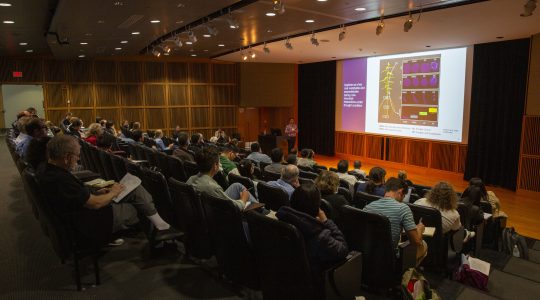
The Interdisciplinary Plant Group (IPG) at Mizzou, a CAFNR Program of Distinction, hosted its 41st annual symposium on the topic of “Root Biology VI” May 20-23 on campus at Bond Life Sciences Center. The symposium covered a broad range of topics, including root development and growth, root function in water and nutrient uptake, responses to abiotic and biotic stress and root-microbe interactions. Research presented spanned spatial and temporal scales and encompassed studies based on model, crop and native species. See photos from the event on CAFNR’s Flickr album. |
|
|
|
GICL hosts Summer Institute »
|
|
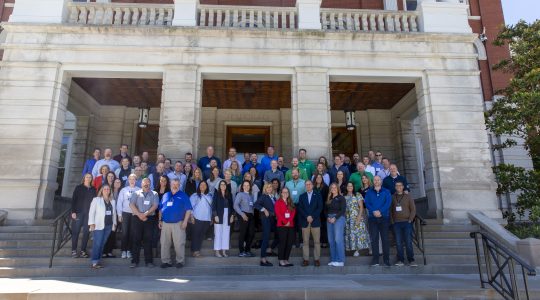
The Graduate Institute of Cooperative Leadership (GICL), a CAFNR Program of Distinction, provides research-based executive and emerging leader education on the unique challenges and opportunities facing agricultural cooperatives. Summer Institute is GICL’s flagship program and was held May 19–22. It is a forum for the exchange of ideas and knowledge, bringing together leaders from the nation’s rich landscape of agricultural cooperatives to explore their commonalities and uniqueness as they delve into the challenges and opportunities facing today’s cooperatives. Summer Institute’s program has roots in the novel “Life Cycle Framework” and uses it to explore both the fundamental dimensions and nuanced evolution of cooperative organizations and cooperative health. There were 68 participants in the 2025 Summer Institute. Participants of Summer Institute are hand-selected and represent diversity in cooperative roles and professional backgrounds. Together, participants explore what makes cooperatives unique from other business forms and how those distinctions are leveraged to sustain long-lived, successful organizations that serve our nation’s producers. Summer Institute participants become part of GICL’s legacy of developing and sharing knowledge to help improve cooperative performance, foster “cooperative genius,” and support each participant’s personal career growth. |
|
|
|
Personal Protection Equipment Compliance Guide »
|
|
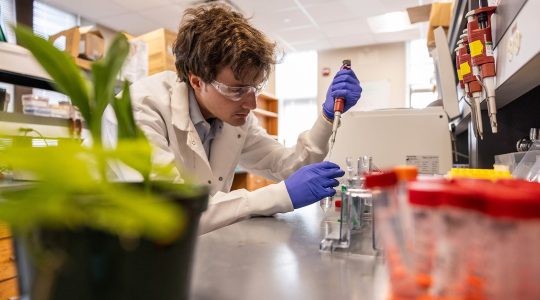
This new guide establishes the University’s minimum expectations for personal protective equipment (PPE) in laboratories using hazardous materials. - Protective Eyewear
Every person shall wear ANSI Z87 approved protective eyewear for protection from splashes and flying particles. Prescription glasses not modified to include side protection do not meet the minimum expectation. - Lab Coats
Every person shall wear a lab coat of appropriate size. Lab coats shall be fastened so that the entire torso is
covered. Sleeves shall provide coverage of the arms down to the wrist. - Laboratory Clothing
Every person shall wear clothing that covers the entire body, except the hands, face, and head. Only footwear with closed toes and closed heels shall be worn inside the laboratory. Shorts and sandals are not permitted.
The use of PPE will be recorded during laboratory inspections. When laboratory occupants are observed meeting minimum expectations, the Principal Investigator will receive an observation of “compliant.” When one or more laboratory occupants are observed not meeting minimum expectations, the Principal Investigator will receive an observation of “not compliant.” Observations will be submitted to the Principal Investigator. As data is collected from multiple laboratories, it will be aggregated and presented to chairs, directors, deans, and the Provost. For PPE selection, purchasing guidance, or any questions about PPE compliance, contact labsafety@missouri.edu or visit the Mizzou Environmental Health and Safety webpage. |
|
|
CAFNR Internal Funding Opportunities |
|
Matching Assistantship Program |
|
CAFNR desires to increase the number of PhD students and postdoctoral research scholars to strengthen AAU metrics and to further strengthen the CAFNR research community. The goal of the CAFNR Matching Assistantship Program (C-MAP) is to support the efforts of our faculty to attract highly competitive PhD students to CAFNR.
Deadline for submission of application documents for the Fall 2025 Semester is June 1.
CAFNR will award C-MAP funds to complement funding from other sources — required as a condition of the award. A maximum of $12,500 for 12 months for up to four years for a new PhD student will be awarded. Annual renewal will be subject to satisfactory progress toward the degree based on annual reviews. C-MAP funds cannot be used to cover tuition, waiver of educational fees, graduate medical insurance subsidy, or other incidental costs (e.g., student recreation center).
Faculty (tenure or non-tenure track) advisors submitting applications for C-MAP must be leading active research programs, have doctoral faculty status, document availability of at least half of the assistantship funding and participate in a Multistate Hatch Project (or will join a Multistate Project by the time the funding is approved).
A subgroup of the CANFR Research Council (CRC) will serve as the selection committee.
|
|
|
CAFNR Dissertation Research Improvement Grant |
|
The CAFNR Office of Research is pleased to offer the CAFNR Dissertation Research Improvement Grant (C-DRIG) for the fifth time. The purpose of this grant is to support dissertation research projects proposed by doctoral students in the college. Eligible students should have completed their coursework and have advanced to candidacy or will advance to candidacy within six months of the C-DRIG awards. This program has helped many talented PhD students in our college fund portions of their dissertation projects, while also gaining valuable grant-writing and management experience.
Proposals will be evaluated by the CAFNR Research Council (CRC), an advisory body that advises the CAFNR Office of Research and is made up of representatives from each Division in the College, and other CAFNR faculty as needed.
Awards have a duration of one year (Aug. 1, 2025, to July 31, 2026), and pre-award costs may be incurred up to 90 days prior to the award start date with approval from the Associate Dean for Research. No-cost extensions will not be granted, and any remaining funds will be reclaimed.
Application deadline is June 1, and approximately five awards of $2,000 each will be provided.
|
|
|
Research Roars |
|
Jeff Wood recognized by agInnovation North Central
Jeff Wood, assistant professor in the School of Natural Resources, was recognized by agInnovation North Central as the recipient of the 2025 agInnovation Early Career Excellence in Agricultural Innovation Award.
The agInnovation Early Career Excellence in Agricultural Innovation Award is given to an early career researcher who strives in their research career to achieve benchmarks reflective of excellence.
CAFNR faculty members have received the following recent grants (listed by Principal Investigator):
Feng Lin, Screening and Selecting Non-Xtend Soybeans for Dicamba Tolerance, University of Arkansas (MSSB), 4/1/25-3/31/26, $25,000
Rob Myers, A Systems Approach to Integrating Crop and Livestock Production through Innovative Cover Crop Grazing, National Fish and Wildlife Foundation, 9/1/24-8/31/27, $943,531.21
Bryon Wiegand, ACQUISITION OF GOODS AND SERVICES-ANIMAL GENETICS, Agricultural Research Service, 4/1/25-3/31/26, $109,599.60
Bradley Wilson, RBTN samples on a large scale, Cotton, Inc., 1/1/25-12/31/25, $4,500
|
|
|
In the News |
|
|
|
|
|
|
|
|